Production Years: 1999 – 2002 (for the US market). The model was supplied to some other markets even later.

The second generation Nissan Quest, developed in close collaboration with Ford, became an iconic model. Essentially, it is a mechanical twin of the Ford Windstar, but with a completely unique exterior and interior, which allowed it to retain its Japanese identity.


Technical Specifications (based on official Nissan catalogs)

Platform: Joint development by Nissan and Ford.

Body: 5-door minivan, unibody construction.

Engine: The only option is a 3.3L gasoline V6 (code VG33E).

Power: 170 hp (at 4800 rpm) — for models until 2001. From 2001, power was increased to 180 hp thanks to a revised intake manifold.

Torque: 265 N·m (at 2800 rpm).

Transmission: Standard — 4-speed automatic transmission (code CD4E).

Layout: Front-wheel drive (FWD). All-wheel drive (4WD) was not offered for this generation (it only appeared in the next, third generation).

Dimensions:

  • Length: ~5110 mm
  • Wheelbase: ~3070 mm

Capacity: 7 passengers (three rows of seats). The seat configuration was very flexible: the second row could be removed, and the third row could be folded into the floor, creating a huge, flat cargo space.


How to Remove the Front Bumper

  1. Open the hood.
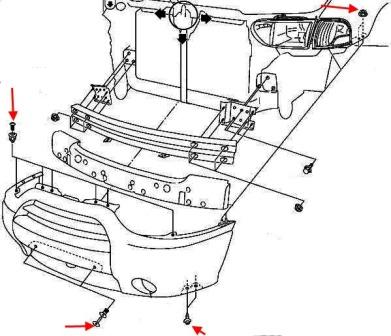
  2. Remove the four clips that secure the top side of the front bumper.
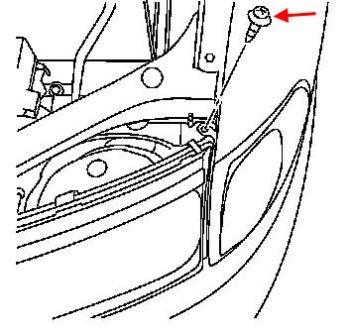
  3. Unscrew one screw on each side and remove the turn signal lights.
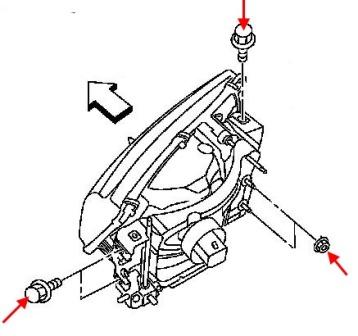
  4. Unscrew six screws and four nuts, then remove the headlights.
  5. Under the headlights, remove two clips.
  6. From underneath the vehicle, unscrew four screws and remove two clips.
  7. In the wheel arches, free the fender liners and unscrew the nuts behind them that secure the sides of the bumper to the fenders.
  8. With an assistant, pull the bumper forward to remove it, and disconnect the electrical connectors.

Nissan Quest II Front Bumper Mounting Diagram

Nissan Quest II Headlight Mounting Diagram


How to Remove the Rear Bumper

⇒Useful tips on how to remove the bumper and not break anything.⇐

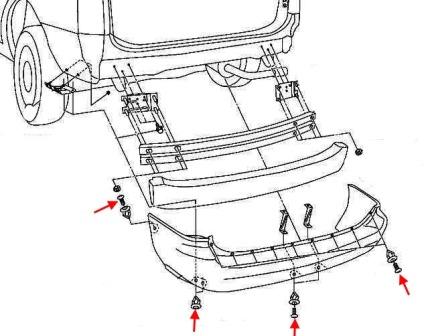
  1. Open the tailgate and remove the nine clips that secure the top side of the rear bumper.
  2. Move to the lower side and remove the six clips inserted from bottom to top.
  3. Remove the clips in the wheel arches that secure the sides of the bumper.
  4. With an assistant, release the fasteners in the fenders and pull the bumper backward to remove it.

Nissan Quest II Rear Bumper Mounting Diagram


Interesting Facts:

  • Platform Twins: The project was developed jointly on a 50/50 basis. Nissan was responsible for the exterior and interior design, while Ford was responsible for chassis development and production at its plant in Avon Lake (Ohio, USA). This is a rare example of a Japanese and American manufacturer creating such visually different cars on a common base.
  • Unique Design: Unlike the streamlined Ford Windstar, the Quest II received an angular, almost "blunt" front end with headlights split into two sections and sharp lines. It was a bold and memorable design that still stands out on the road today.
  • Safety: In 2001, the model underwent a facelift, which included improved front brakes (discs instead of drums on all trims) and additional body stiffeners. After this, it earned the highest 5-star rating in NHTSA frontal crash tests.


Advantages and Disadvantages

Advantages:

  • Reliable naturally aspirated V6 engine: The VG33E engine is known for its longevity and durability with timely maintenance.
  • Spacious and versatile interior: One of the most spacious interiors in its class at the time. Convenient seat transformation.
  • Unique appearance: stands out among more streamlined competitors.
  • Comfortable suspension: absorbs road imperfections well, providing a smooth ride.

Disadvantages:

  • Transmission issues: The main "weak point". The 4-speed automatic transmission CD4E does not tolerate overheating, aggressive driving, or delayed fluid changes. It is prone to wear and failure, which is a common problem for the entire platform.
  • Unreliable electronic components: electronic sensors and modules (e.g., throttle position sensor) can cause trouble over time.
  • Noise at high RPM: The engine is quite loud during hard acceleration.
  • Fussy power steering: Leaks and whining in the power steering system can occur as the vehicle ages.