The third generation of the Nissan X-Trail was introduced in the fall of 2013 and was produced until 2021 (in some countries until 2022). The model's body code is T32. This generation marked a radical departure from its predecessors, swapping the angular off-road appearance for a more urban crossover style.

Technical Specifications

  • Platform: The model is built on the modular CMF (Common Module Family) platform from the Nissan-Renault alliance, which provided increased body rigidity and improved noise insulation.
  • Engines:
    • Gasoline: 2.0L (MR20DD, 144 hp) and 2.5L (QR25DE, 171 hp).
    • Diesel: 1.6L (R9M, 130 hp) – for the European market.
    • Hybrid: (for some markets) 2.0L gasoline + electric motor, with a combined output of about 200 hp.
  • Transmission: 6-speed manual transmission, Xtronic CVT (main option), and 6-speed automatic transmission (for all-wheel-drive versions with the 2.5L engine in early production models).
  • Drivetrain: Front-wheel drive (2WD) or all-wheel drive (4WD) with the ALL MODE 4×4-i system. The system offered mode selection: 2WD, Auto (automatic torque distribution), and Lock (50:50 distribution lock at low speeds).
  • Suspension: Independent front (MacPherson struts) and rear (multi-link design).

How to Remove the Front Bumper

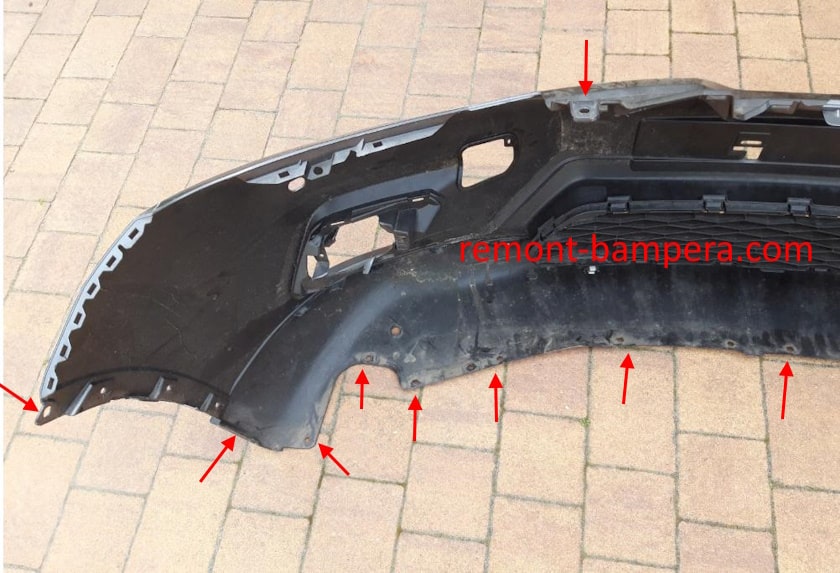
  1. Open the hood.
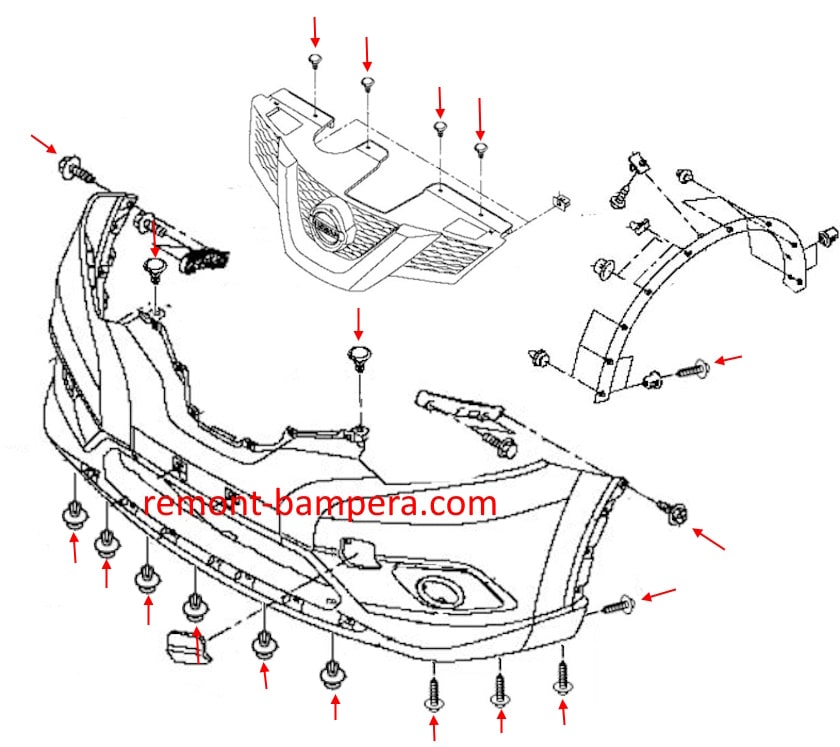
  2. Under the hood, remove four plastic push clips, release them from the retainers at the bottom, and remove the radiator grille.
  3. Under the grille, remove two push clips that secure the top part of the front bumper.
  4. At the bottom, unscrew six screws that secure the fender liners and remove six push clips that secure the engine compartment undercover.
  5. Turn the wheels fully to the left or right side, depending on which side you are working on.
  6. In the wheel arches, unscrew three screws on each side that secure the plastic arch liners and fender liners.
  7. Release the arch liners from the bumper (they are held by clips, pull towards yourself).
  8. Behind the liners, unscrew one screw on each side that secures the bumper corners to the fenders.
  9. With an assistant, release the clips in the fenders and carefully pull the bumper straight forward.
  10. Disconnect the connectors from the fog lights (if equipped).
  11. Disconnect the connector from the parking sensors (if equipped).
  12. If equipped with headlight washers, disconnect the hoses (fluid may leak out).

Nissan X-Trail III T32 (2013-2022) front bumper mounting locations

Nissan X-Trail III T32 (2013-2022) Front Bumper Mounting Diagram


How to Remove the Rear Bumper

⇒Useful tips on how to remove the bumper and not break anything.⇐

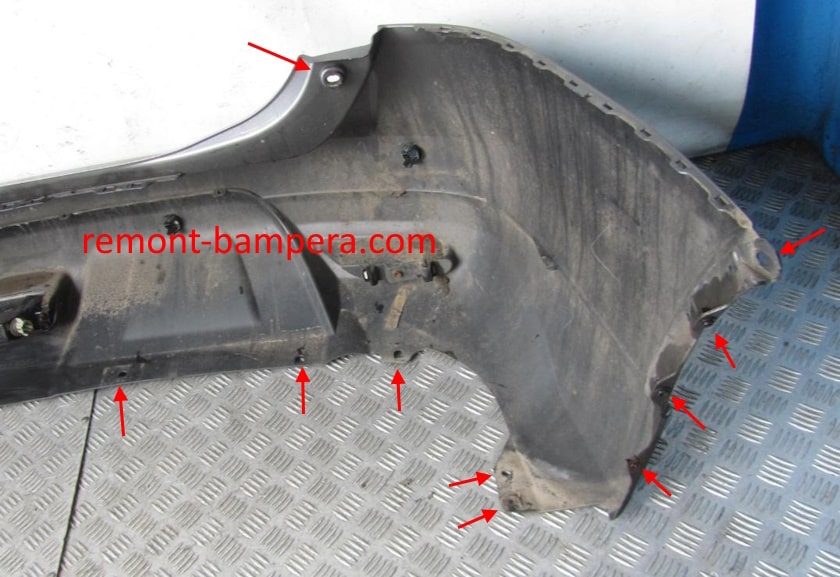
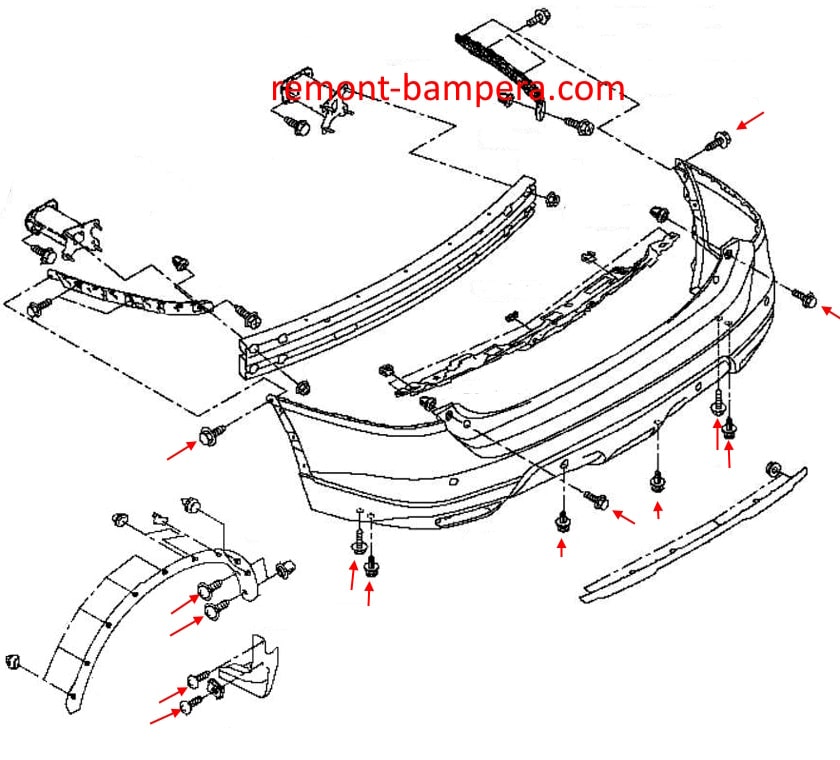
  1. From under the vehicle, remove four push clips and unscrew six screws that secure the lower part of the rear bumper.
  2. In the wheel arches, unscrew the screws that secure the splash guards and arch liners (to avoid removing the wheels, it's more convenient to use a ratchet with a socket).
  3. Release the wheel arch liners from the bumper (they are held by clips, pull towards yourself).
  4. Behind the liners, unscrew one screw on each side that secures the corners to the fenders.
  5. Open the trunk lid and remove two plugs in the opening.
  6. Under the plugs, unscrew one screw on each side that secures the top part.
  7. With an assistant, carefully release the clips in the fenders (pull towards yourself) and pull the bumper straight back.
  8. Disconnect the electrical connectors (if equipped).

Nissan X-Trail III T32 (2013-2022) rear bumper mounting locations

Nissan X-Trail III T32 (2013-2022) rear bumper mounting diagram


Interesting Facts

  • Concept Change: The T32 was not just a successor to the X-Trail, but also effectively a replacement for the Nissan Qashqai+2 (Qashqai with a third row of seats), occupying that market niche.
  • Third Row of Seats: For the first time in the X-Trail model's history, an optional third row of seats became available, turning it into a 7-seater crossover, although the space there was designed exclusively for children.
  • Safety Technology: The model was one of the first in its class to feature the Nissan Safety Shield complex of safety systems, including blind-spot monitoring, forward collision warning with automatic braking, and lane departure warning.
  • Sales Paradox: Despite criticism from fans for losing its "off-road" character, the T32 became the most commercially successful generation in the history of the X-Trail worldwide.


Pros and Cons

Pros:

  • Practical Interior: Spacious, ergonomic, and high-quality cabin. Very roomy trunk. The optional third row is a key advantage for families.
  • Comfort: Excellent ride smoothness and a high level of noise insulation on the highway. The soft suspension handles bumps well.
  • Fuel Efficiency: The 2.0L engines paired with the CVT demonstrate reasonable fuel consumption for their class.
  • Reliable Transmission: Unlike some other models, the CVT in the X-Trail T32 has proven to be a fairly reliable unit with timely maintenance.

Cons:

  • Performance: The CVT's characteristic "hesitation" and monotonous acceleration. Lack of sharpness and sporty character. The 2.0L engine may be insufficient for a fully loaded vehicle.
  • Off-Road Capability: Despite the all-wheel-drive system, off-road capability compared to previous generations (T30, T31) is significantly reduced due to the lack of a low-range transfer case and a locking differential. It is more of a soft-roader for light off-road use.
  • Unreliable Components: For specific model years and markets, there were common issues: fogging headlights, rapid wear of the front control arm bushings, interior squeaks and rattles.
  • Resale Value: High initial cost and a large number of offerings on the used market lead to a fairly sharp depreciation in value.