The Second Generation Mitsubishi Pajero (for the European market — Montero, Mitsubishi Shogun in the UK)

Production Years and Facelift

  • First Show: The model was introduced in 1991 (as a 1992 model year) for the Japanese and North American markets. The car often arrived on the European market with a slight delay.
  • Main Production for Europe: 1992 — 1999.
  • Facelift: A key facelift occurred in 1994 (for the 1995 model year).


Technical Specifications

The second generation was offered in two body styles: 3-door (SWB) and 5-door (LWB).

  • Engines (for the European market):
    • Petrol:
      • 3.0L V6 (6G72): Power approx. 150 hp. A reliable and sufficiently torquey naturally aspirated engine that became the main one for many markets.
      • 3.5L V6 (6G74): Appeared later, power approx. 200 hp. Installed on top versions.
    • Diesel (most popular in Europe):
      • 2.5L TD (4D56T): Turbo diesel with 85-99 hp. A legendary engine, known for its phenomenal reliability and fuel efficiency, but low dynamics.
      • 2.8L TD (4M40): A more modern and powerful (125 hp) turbo diesel that replaced the 2.5-liter engine during the facelift.
  • Transmission and Drivetrain:
    • Transmission: 5-speed manual or 4-speed automatic.
    • Drivetrain: Permanent four-wheel drive with a transfer case featuring two modes:
      • 2H (rear-wheel drive for highways).
      • 4H (four-wheel drive for slippery surfaces).
      • 4HLc (four-wheel drive with locked center differential for off-road).
      • 4LLc (low-range gear for severe conditions).
    • Suspension: Independent front torsion bar suspension and dependent rear leaf spring suspension. This scheme provided an excellent balance between on-road comfort and off-road capability.

How to Remove the Front Bumper

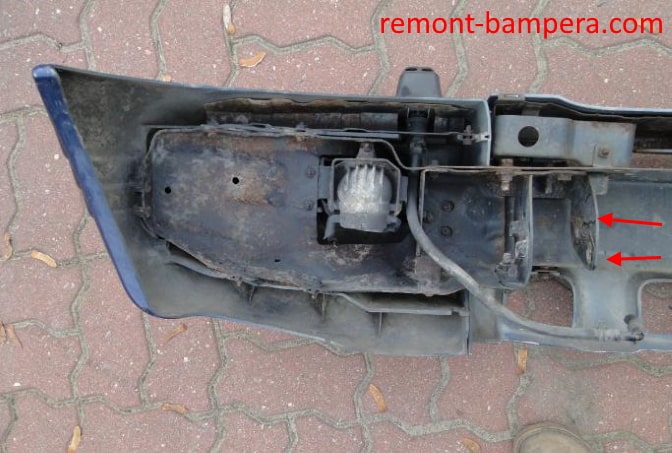
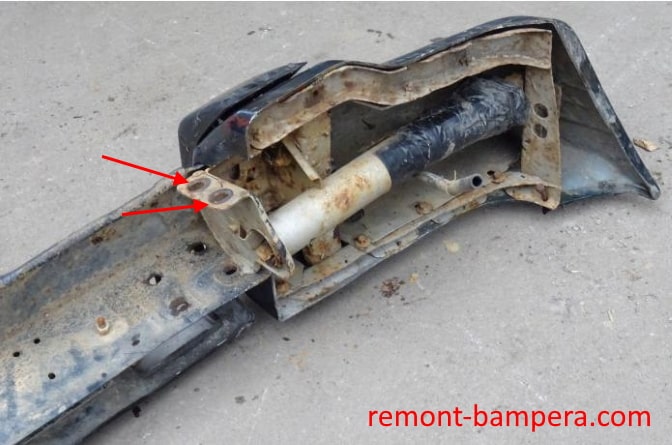
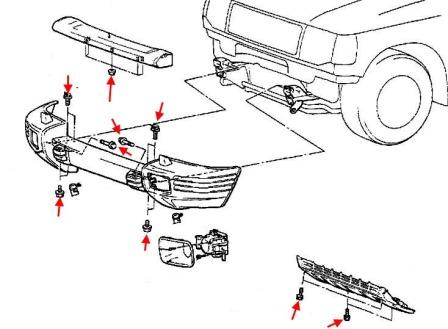
Get under the bumper and disconnect the electrical connectors and headlight washer hoses (if equipped). Unscrew the four bolts that secure the metal bumper reinforcement to the body (you will need a ratchet with a socket). Then, with an assistant, pull the bumper forward.

Mitsubishi Pajero/Montero II front bumper mounting locations

Mitsubishi Pajero/Montero II front bumper mounting locations

Mitsubishi Pajero/Montero II front bumper mounting diagram

Mitsubishi Pajero/Montero II front bumper mounting diagram


How to Remove the Rear Bumper

⇒Useful tips on how to remove the bumper and not break anything.⇐

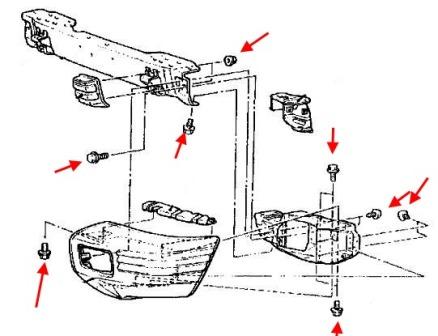
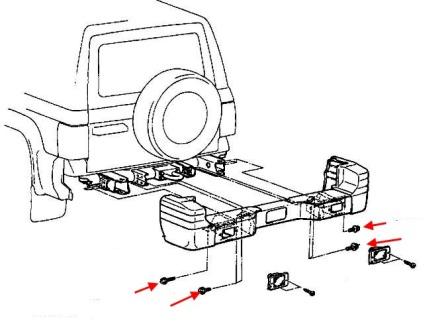
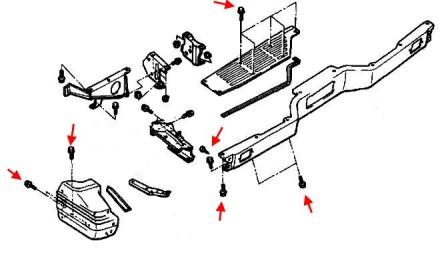
Disconnect the electrical connectors (if equipped). From underneath the vehicle, unscrew the bolts securing the reinforcement to the body (the bolts can be hard to unscrew, you will need a long ratchet with a socket). With an assistant, pull the bumper backward.

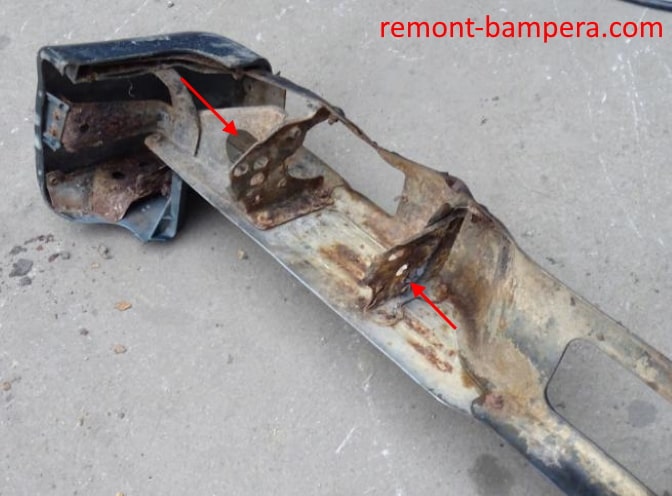
Mitsubishi Pajero/Montero II (1991–2004) rear bumper mounting locations

Mitsubishi Pajero/Montero II rear bumper mounting diagram

Mitsubishi Pajero/Montero II rear bumper mounting diagram


Interesting Facts About the Model:

  • Dakar Debut: The second generation Pajero debuted at the Dakar rally-raid in 1992 and immediately took second place. From 1993, the unprecedented hegemony of the Pajero in this legendary competition began, where it won numerous overall victories.
  • ASTC System: Mitsubishi was a pioneer in electronic assistance systems. ASTC, introduced in 1995, used individual wheel braking to prevent understeer and oversteer, which was revolutionary for an SUV.
  • Robust Body: The Montero II body had a powerful ladder frame, making it exceptionally strong and durable in harsh operating conditions.


Advantages and Disadvantages

Advantages:

  • Outstanding Off-Road Capability: Thanks to successful geometry, a powerful frame, reliable transmission, and (on some versions) the ASTC system, the Montero II was one of the best in its class.
  • Phenomenal Reliability: This especially applies to the 4D56T and 4M40 diesel engines. Many examples have covered hundreds of thousands of kilometers.
  • Repairability: The simple and proven design made maintenance and repair relatively inexpensive.
  • Comfort for an SUV: Compared to the first generation and many competitors, the interior was more comfortable and better insulated from noise.

Disadvantages:

  • High Fuel Consumption: Especially for the petrol V6 versions, which could reach 15-18 l/100 km or more.
  • On-Road Handling: The high center of gravity and rear leaf spring suspension caused significant body roll in corners.
  • Age-Related Issues: Today, most vehicles are of a solid age, which means battling rust (especially in the wheel arches and sills) and wear of all rubber components.
  • Low Performance: Diesel versions, especially the 2.5 TD, were rather slow to accelerate.