The first-generation Mitsubishi Eclipse Cross was manufactured from 2017 to 2025, model codes
GK/GL/YA/YB.
Model Years and Facelift
- Initial Release: 2017. The model was unveiled at the Geneva Motor Show in March 2017, with sales in Europe and Russia starting in late 2017 – early 2018 of the model year.
- Facelift: 2021. This was not just a bumper change, but a comprehensive update that affected key exterior elements. The most significant change was the complete abandonment of the controversial split rear window in favor of a conventional panoramic glass and a larger tailgate. The model also received a new radiator grille, larger headlights, and a different rear bumper, bringing it visually closer to the Outlander.
Technical Specifications (for Russian and European markets)
- Engine: The only gasoline engine was the turbocharged 1.5-liter MIVEC-T (4B40). Its power output was 150 hp at 5500 rpm, with a torque of 250 Nm at 1800-4500 rpm.
- Transmission:
- 6-speed manual gearbox (front-wheel drive).
- Jatco CVT8 continuously variable transmission (CVT) (both front-wheel and all-wheel drive).
- Drivetrain: Front-wheel drive (2WD) or an on-demand all-wheel drive (4WD) with the S-AWC (Super All Wheel Control) system, which included active stability control and torque vectoring to the rear wheels.
- Dimensions: Length ≈ 4405 mm (pre-facelift), ≈ 4545 mm (post-facelift). Wheelbase — 2670 mm.
Bumper Plastic Marking: >PP+E/P-TD20<
Note: Fastener locations may vary depending on the model year.
How to Remove the Front Bumper
- Open the hood.
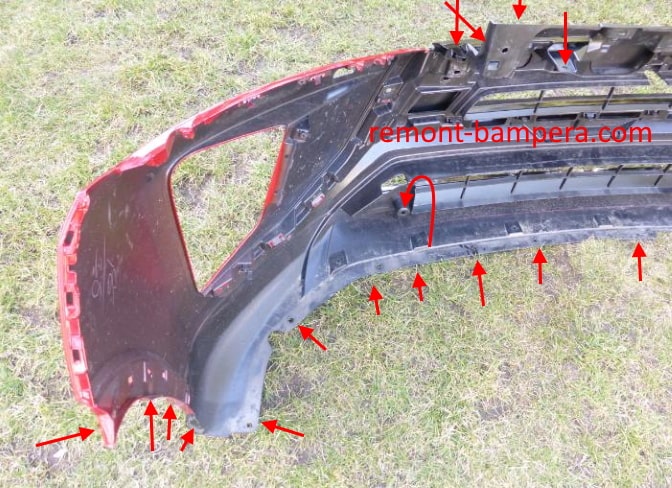
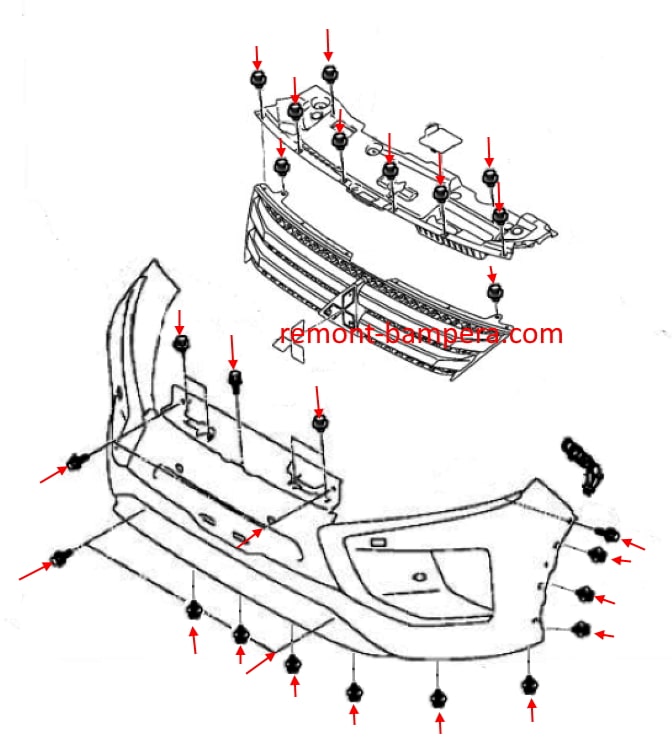
- Under the hood, remove eight push-type fasteners and take off the cover above the radiator grille.
- Under the cover, remove two push-type fasteners and detach the radiator grille (held by clips).
- Under the radiator grille, unscrew three screws and remove four push-type fasteners that secure the top part of the bumper.
- Unscrew two screws in the lower grille of the bumper.
- From underneath the vehicle, remove twelve push-type fasteners that secure the lower part to the underbody protection and wheel arch liners.
- Turn the wheels to the side, depending on which side you are working on.
- In the wheel arches, remove three push-type fasteners on each side that secure the arch liners and fender liners (front part).
- Release the arch liners from the bumper (grab the bottom and pull towards yourself).
- Under the liners, unscrew one screw on each side that secures the corners to the fenders.
- Release the clips in the fenders (pull the corners towards yourself) and, with an assistant, carefully slide the bumper forward (mind the wires and hoses).
- Disconnect the electrical connectors (if any).
- If the car has headlight washers, disconnect the hoses (note that fluid may leak from the reservoir).


How to Remove the Rear Bumper
- Open the tailgate.
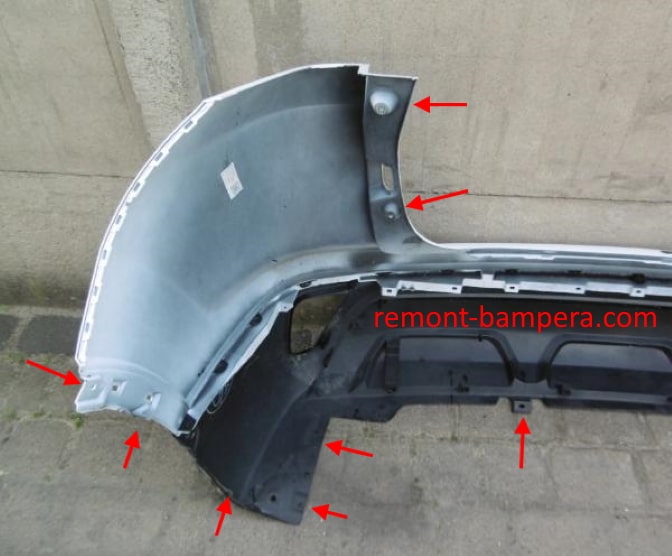
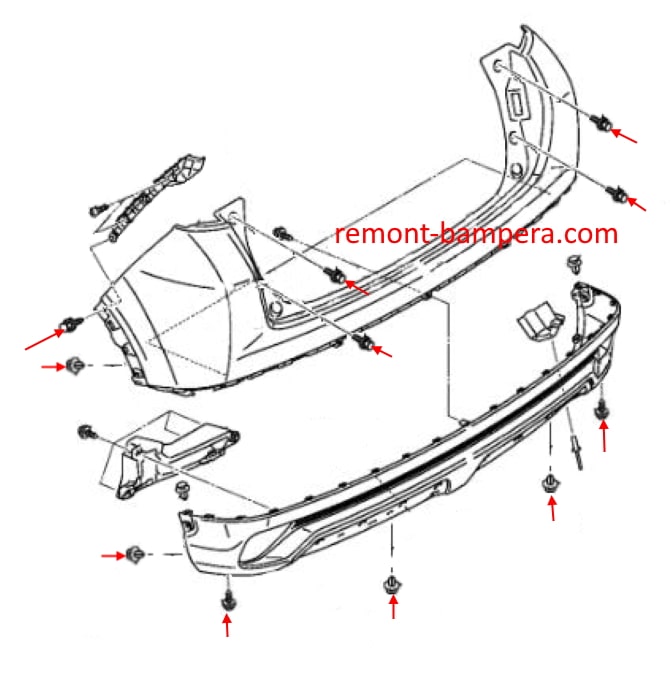
- In the trunk opening, unscrew four screws.
- From underneath the vehicle, remove push-type fasteners and unscrew the screws (inserted and screwed from bottom to top).
- In the wheel arches, remove the push-type fasteners that secure the arch liners and fender liners (rear part).
- Release the arch liners from the bumper (grab the bottom and pull towards yourself).
- Under the arch liners, unscrew one screw on each side that secures the bumper corners to the fenders.
- Release the clips in the fenders (pull the bumper corners towards yourself).
- With an assistant, slide the rear bumper backward (mind the wires).
- Disconnect the electrical connectors.


Interesting Facts about the Model
- Name Revival: The "Eclipse" name is a nod to the iconic Mitsubishi Eclipse sports coupe produced from 1989 to 2011. However, the crossover has no technical connection to it.
- Controversial Design: The original two-section rear end with a narrow window and a window on the tailgate was met with mixed reactions. Many criticized it for poor rear visibility, which led to this design being abandoned after the facelift.
- Generous Equipment: Even in base versions, the Eclipse Cross often offered a good level of features, including a multimedia system with a touchpad and smartphone support, as well as bucket-style front seats to emphasize its sporty character.
Pros and Cons
Pros:
- Performance: The turbocharged engine provides good low-end and mid-range torque, making the car quite peppy in the city compared to naturally-aspirated rivals.
- Effective All-Wheel Drive: The S-AWC system is considered one of the best in its class for light off-roading and confident driving on slippery roads.
- Handling: The chassis, tuned for Europe, offers precise and composed handling.
- Comfort: The suspension handles road imperfections well, providing a decent level of comfort.
Cons:
- Cramped Interior: Despite the long wheelbase, rear passenger space and trunk volume (≈ 374 liters) are inferior to many competitors (e.g., Toyota RAV4 or Nissan X-Trail).
- Noisy Engine at High RPM: During hard acceleration, the turbo engine produces an unpleasant sound and causes the CVT to rev high.
- Outdated Pre-facelift Multimedia: Many owners complained about the inconvenient touchpad control and not the most intuitive interface.
- High Fuel Consumption: With aggressive driving, real-world fuel consumption can be significantly higher than the official figures.
Italiano
Français
русский
English
Deutsch
Español