Production Years and Names
The first generation was sold under two main names.
- 2001–2008 Mitsubishi Airtrek
- 2003–2006 Mitsubishi Outlander
In 2003, a sporty Outlander Ralliart version with a tuned suspension and unique body kit was introduced for the US market.
Technical Specifications
Platform and Construction:
The model was based on the Mitsubishi ASX platform (not to be confused with the later crossover), which, in turn, was closely related to the Mitsubishi Lancer platform. This gave the car better handling than body-on-frame SUVs. Drive type – front-wheel drive (2WD) or all-wheel drive (4WD).
Engines:
- Petrol:
- 2.0L (4G63): Power approx. 130 hp. The base version for many markets.
- 2.4L (4G64): Power approx. 160 hp. The main engine for the USA and other markets, offering better performance.
- 2.0L MIVEC (4G63): Power approx. 155 hp. A more modern version with variable valve timing.
- Diesel (Europe only):
- 2.0L DI-D (4N14): Power 136 hp. A reliable and economical engine from Volkswagen.
- Sport (Airtrek Turbo/Ralliart):
- 2.0L Turbo (4G63T): Power 240–250 hp. This was the same famous turbocharged engine used in the Mitsubishi Lancer Evolution, but in a detuned version. It turned the crossover into a true "family sports car."
Transmission:
- 5-speed manual transmission.
- 4-speed automatic transmission (INVECS-II).
- The sport version with the 2.0L Turbo engine was only equipped with the 4-speed automatic.
Bumper plastic marking: >PP+E/P<
Mounting points may vary slightly.
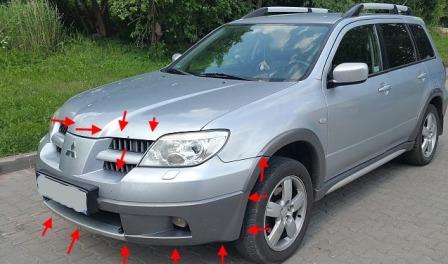
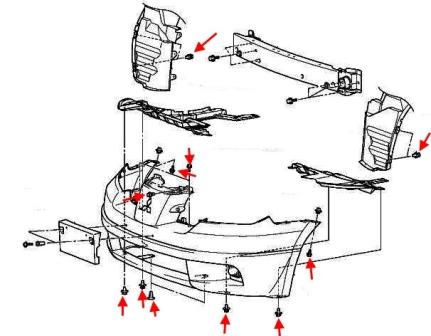
How to Remove the Front Bumper
- Open and secure the hood.
- Remove the four clips securing the radiator grilles.
- Using a flat-head screwdriver through the holes, release the four fasteners and remove the radiator grilles.
- Remove two clips and unscrew two bolts securing the top part of the front bumper.
- Move to the lower part. From under the car, remove eight clips.
- For better access, turn the wheels to the side.
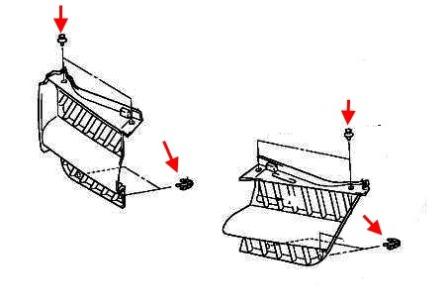
- In the wheel arches, remove four clips securing the fender liners to the bumper, and unscrew two bolts (fastened from bottom to top) that secure the bumper corners to the fenders.
- Release the fasteners in the fenders, grab the corner of the bumper, and pull it towards you with moderate force.
- With an assistant, remove the bumper forward and disconnect the connectors from the fog lights.


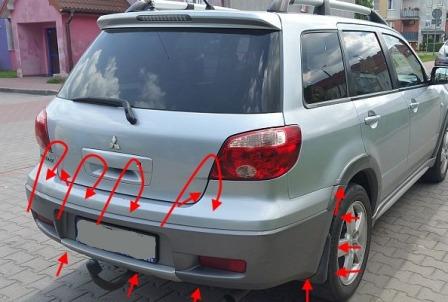
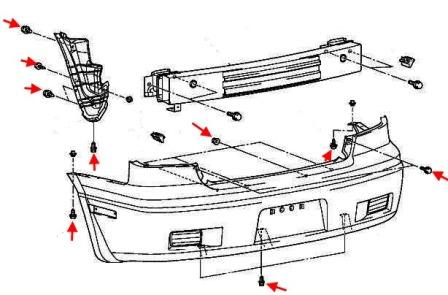
How to Remove the Rear Bumper
- Open the trunk lid.
- In the trunk opening, unscrew two bolts.
- Remove the trunk rear trim panel and unscrew four nuts located underneath it.
- In the trunk side trims, open the covers and release the fasteners underneath them.
- Move to the lower edge of the bumper and remove five clips here (inserted from bottom to top).
- Now, in the wheel arches, remove the clips securing the fender liners to the bumper.
- Unscrew two bolts (fastened from bottom to top) that secure the bumper corners to the fenders.
- Release the fasteners in the fenders and, with an assistant, remove the bumper backward.
- Disconnect the electrical connectors.


Interesting Facts About the Model:
- Initially "Airtrek": The Outlander name was not originally planned for the global model. "Airtrek" reflected the concept of freedom of movement, but for international markets, the more "geographical" and understandable name Outlander was chosen.
- Technology from the Evo: The use of the turbocharged 4G63 engine from the Lancer Evolution (albeit in a detuned state) is the model's main highlight. This made the Airtrek Turbo/Outlander Ralliart one of the fastest crossovers of its time.
- Joint Development with Volkswagen: The diesel engine for European versions was supplied by the Volkswagen Group, which was part of a strategic partnership between the two companies.
- Unique Design: The first-generation Outlander stood out from competitors with its angular, "cyberpunk" design featuring triangular motifs in the headlights and pillars, characteristic of Mitsubishi's design language of that era.
Advantages and Disadvantages
Advantages:
- Excellent Handling: Thanks to the lightweight construction and Lancer-based platform, the car felt confident and fun to drive.
- Powerful Turbo Engine: The version with the 4G63T engine offered a unique combination of practicality and high performance for its class.
- Practicality: Spacious cabin and large trunk.
- Reliability (Naturally Aspirated Versions): The naturally aspirated 2.0L and 2.4L petrol engines are known for their durability and ease of maintenance.
Disadvantages:
- Poor Sound Insulation: The cabin could be quite noisy at high speeds.
- Interior Material Quality: The plastic in the interior was quite hard and simple, even by the standards of the time.
- High Fuel Consumption of the Turbo Version: The Outlander with the 4G63T engine consumed a lot of fuel.
- Age-Related Issues: Today, all these cars are old, and typical problems can include squeaks in the suspension, corrosion, and failures of aging electronics.
Italiano
Français
русский
English
Deutsch
Español