The Mitsubishi 3000GT is a Grand Touring sports coupe manufactured from 1990 to 2000. It was the flagship model for Mitsubishi and part of a joint project with Dodge, which sold it as the Dodge Stealth. While there was only one generation, the car underwent several significant facelifts during its production run.
Initially introduced in 1990, the 3000GT was notable for its futuristic design, which included pop-up headlights (on early models) and active aerodynamics on the top-tier versions. The car was positioned as a high-tech sports car, filled with innovations for its time.
Technical Specifications (VR-4 Version Example)
Technical specifications varied greatly depending on the model. The base model (SL) was front-wheel drive and featured a naturally aspirated V6 engine, but the true flagship was the VR-4 version.
- Engine: 3.0-liter twin-turbocharged V6 (6G72), 24 valves.
- Power: After the 1994 facelift — 320 hp at 6000 rpm.
- Torque: 427 Nm (315 lb-ft) at 2500 rpm.
- Drivetrain: All-wheel drive (4WD) with an ECS system for torque distribution.
- Transmission: 6-speed manual or 4-speed automatic (for lower trims).
- 0-100 km/h (0-62 mph): Approximately 5.6 seconds.
- Top Speed: Electronically limited to 250 km/h (155 mph).
Innovative Systems (VR-4 Version):
- All-wheel drive with selectable driving modes.
- Active AWD system with vectoring torque control.
- Active exhaust system for backpressure optimization.
- Active aerodynamics: front spoiler and rear wing, automatically deploying at high speed.
- Electronically Controlled Suspension (ECS).
Bumper Plastic Marking: >TPO<
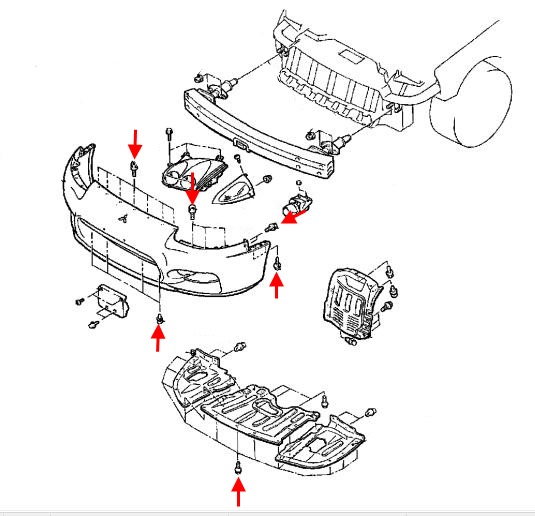
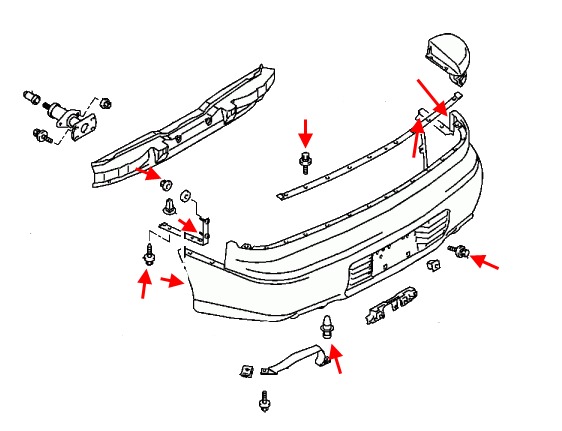
Mounting points differ depending on the model year.
Front Bumper Removal

Rear Bumper Removal

Interesting Facts:
- Twin Brother: The Dodge Stealth was virtually identical to the 3000GT until the 1994 facelift. Interestingly, the Stealth RT/Twin Turbo was named "Import Car of the Year" by Motor Trend magazine in 1991, surpassing its Japanese sibling in media recognition.
- Technology Flagship: In its day, the 3000GT VR-4 was one of the most technologically advanced cars in the world, offering features that only became commonplace years later.
- Headlight Evolution: After the 1994 facelift, the pop-up headlights were replaced with fixed, transparent headlight units, a change driven by stricter passive safety regulations.
- Racing Participation: Despite its weight, the 3000GT competed in various racing series, including the Japanese JGTC championship.
Pros and Cons
Pros:
- Power and Potential: The VR-4 engine had significant tuning potential.
- High Tech Level: An extensive set of innovative systems for its time.
- Comfort and Features: High-quality interior, good sound insulation, and rich equipment (climate control, premium audio system).
- Confident Road Manners: All-wheel drive and electronically controlled suspension provided excellent stability.
Cons:
- High Weight: This was the model's main drawback. The VR-4 weighed around 1750 kg, which negatively impacted acceleration and handling compared to lighter rivals (Nissan 300ZX, Toyota Supra).
- Complexity and High Maintenance Cost: The abundance of complex electronics and cramped engine bay made repairs very labor-intensive and expensive. With age, issues with electronics (ECS suspension, AWD system) become common.
- Unreliable Automatic Transmission: The automatic transmission in equipped versions had a limited lifespan, especially under high load.
Conclusion:
The Mitsubishi 3000GT VR-4 remains in history as an ambitious and incredibly technologically advanced sports car for its time, one that was ahead of its era. However, its main strengths—the complex engineering systems—have, with age, become its main weakness, turning ownership into a hobby for true enthusiasts.
Italiano
Français
русский
English
Deutsch
Español