Model years and generations
- Presentation and sales start: The model was first introduced in 2003.
- Facelift: In 2007, the Grandis underwent a minor facelift, which included a new radiator grille, slightly modified bumpers and headlights, and an updated instrument panel.
- Discontinuation: Production for the European and Russian markets ended in 2011, after which the model did not receive a direct successor.
Technical specifications
The Grandis was built on a platform shared with the Mitsubishi Outlander XL and the Citroën C-Crosser/Peugeot 4007.
- Body: 5-door minivan. Dimensions: length ~ 4785 mm, width ~ 1800 mm, height ~ 1655 mm. Wheelbase — 2830 mm.
- Engines: The most common and relevant for the Russian and CIS markets is the 2.4-liter gasoline engine (4G69) with MIVEC. Its power was 165 hp at 6000 rpm, and torque was 217 Nm at 4000 rpm.
- Transmission:
- 4-speed automatic transmission INVECS-II (for early versions).
- Modern 6-speed robotic transmission with two clutches (Twin Clutch SST) — an option that appeared after the facelift.
- Front-wheel drive.
- Performance and fuel consumption: Acceleration from 0 to 100 km/h took about 10-11 seconds. Declared fuel consumption: 10-12 l/100 km in the combined cycle, in the city it could reach 13-15 l.
Bumper plastic marking: >PP+E/P<
Depending on the year of manufacture, the mounting points may vary slightly.
Before dismantling, be sure to treat all bolts with penetrating lubricant.
How to remove the front bumper
- Open and secure the hood.
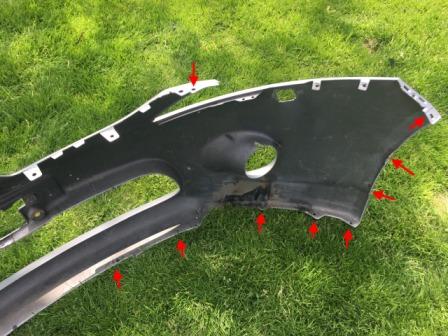
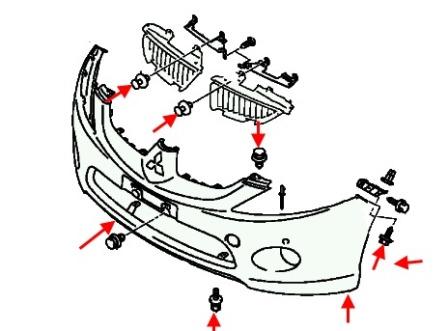
- Remove the eight clips that secure the radiator grille and the top part of the front bumper to the crossmember.
- Move to the lower side, remove six clips here and unscrew two screws that are installed from bottom to top.
- For convenience, turn the front wheels to the side.
- In the wheel arches, remove the clips and pull the fender liners out of the bumper.
- Behind the fender liners, unscrew two screws (one on the left and one on the right side) that secure the bumper corners to the fenders.
- Pull the bumper corners down and towards you to release the latches in the fenders.
- With an assistant, remove the bumper forward and disconnect the connectors from the fog lights.


How to remove the rear bumper
- Open the trunk lid.
- In the trunk side trims, open the covers.
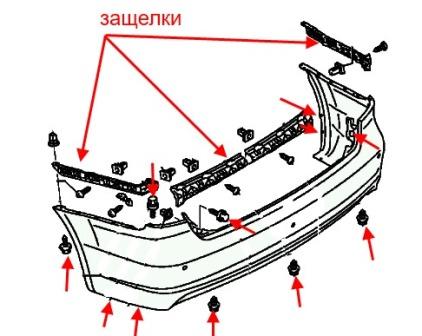
- Under the covers, unscrew two nuts; in the trunk opening, unscrew eight screws and remove the rear lights.
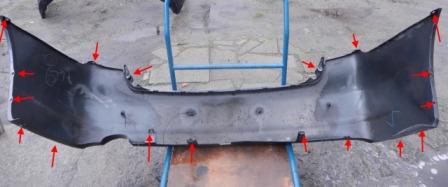
- Unscrew four screws that secure the top part of the rear bumper.
- Move to the lower part. Unscrew the screws and remove the clips that are installed from bottom to top.
- Unscrew the screws in the wheel arches and release the fender liners from the bumper.
- Move the fender liners aside and unscrew two screws that secure the bumper corners to the fenders.
- Pull the bumper corners down and towards you to release the latches in the fenders.
- With an assistant, remove the bumper backwards and disconnect the electrical connectors.


Interesting facts about the model:
- Innovative transmission: The Grandis was one of the first minivans in the world to be offered with a 6-speed robotic gearbox with a dual clutch (Twin Clutch SST), which was a major technological leap for its class.
- Flexible interior: Thanks to the 2830 mm wheelbase, the cabin was very spacious. The third-row seats were comfortable enough for children and even adults on short trips. The second-row seats could not only slide but also swivel 180 degrees, forming a kind of lounge.
- Joint development: The platform and the 2.4 MIVEC engine were used within the alliance between Mitsubishi and the PSA (Peugeot-Citroën) group for the C-Crosser and 4007 crossovers.
Advantages and disadvantages
Advantages:
- Spacious and transformable interior: Excellent layout variability for different needs.
- Stylish and modern design: Even today, the Grandis doesn't look too outdated.
- Reliable 4G69 gasoline engine: Known for its longevity and unpretentiousness with timely maintenance.
- Good equipment: For its class, it offered many options, including climate control, leather interior, cruise control, and a panoramic roof.
- Confident road manners: In terms of handling, it was closer to a station wagon than a "wobbly" minivan.
Disadvantages:
- High fuel consumption: Especially in the city cycle — the model's Achilles' heel.
- Unreliability of the robotic gearbox (Twin Clutch SST): This expensive and complex unit eventually became a source of problems (jerking, overheating, expensive repairs). Versions with the classic "automatic" are more reliable.
- Expensive maintenance: Spare parts and repairs are more expensive than those of its classmates.
- Age: Most Grandis on the used car market already have substantial mileage and age, which requires a thorough inspection of the body condition (hidden rust) and all technical systems.
Italiano
Français
русский
English
Deutsch
Español