Production years and body types
The E60/E61 generation was produced for the European market from 2003 to 2010 (official sales began in late 2003 as the 2004 model year). In 2007, the model underwent a facelift (LCI – Life Cycle Impulse), which affected the lighting, bumpers, and equipment.
- E60 – Sedan (4 doors).
- E61 – Wagon (5 doors, designated "Touring"). Fun fact: the wagon was developed in parallel with the sedan, not after it, which resulted in harmonious body proportions.
Technical specifications (overview)
The E60 platform was revolutionary, being the first in its class to feature an aluminum suspension (front double-wishbone, rear multi-link Integral IV) and electromechanical power steering. The engine lineup was extensive:
- Petrol: Ranging from a 4-cylinder 2.0L (150 hp in the 520i) to the legendary naturally aspirated V10 S85 with a 5.0L displacement (507 hp in the M5). The inline-six engines (M54, later N52/N53) with 2.5 and 3.0-liter displacements (218-272 hp) were particularly popular, benchmark for smoothness and responsiveness.
- Diesel (highly sought after in Europe): From 2.0L (163 hp in the 520d) to 3.0L twin-turbo (M57, 286 hp in the 535d). The M57TU2D25 engine in the 530d (235 hp) is considered one of the most reliable and successful in the lineup.
- Transmissions: 6-speed manual, 6-speed ZF automatic (from 2005), and from 2008 – one of the world's first 7-speed dual-clutch automated manual transmissions (SMG Drivelogic for the M5, M DCT for the M5 and M6 from 2009).
Bumper plastic markings: >PP+EPDM-20%TV< front, >PP+EPDM-TX20< rear.
Note: Mounting points vary slightly depending on the year of manufacture and model.
How to remove the front bumper
- Open and secure the hood.
- Pull up and remove the trim panel along with the hood seal.
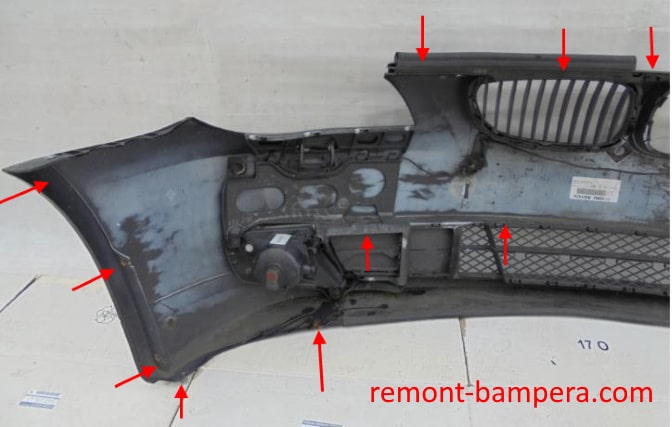
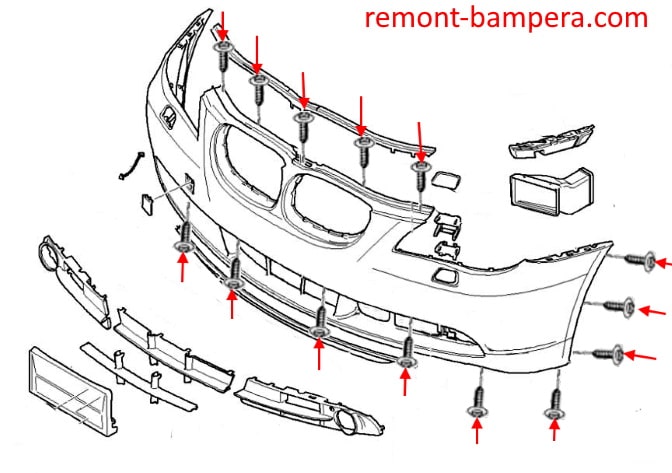
- Under the panel, unscrew the five bolts (fastened top-to-bottom) that secure the top part of the front bumper.
- In front of the lower bumper grille, unscrew the four (two) bolts fastened bottom-to-up.
- Unscrew the two (four) bolts from the underside/underbody area.
- Move to the wheel arches. Turn the front wheels fully to the side.
- Unscrew the three bolts on each side (left and right) that secure the front part of the wheel arch liners.
- Release the clips in the fenders by pulling the bumper corners towards you. If the clips are very tight, unscrew the four bolts behind the wheel liners that secure the plastic brackets.
- With an assistant, carefully pull the bumper forward and disconnect the electrical connectors.


How to remove the rear bumper
- Open the trunk/tailgate.
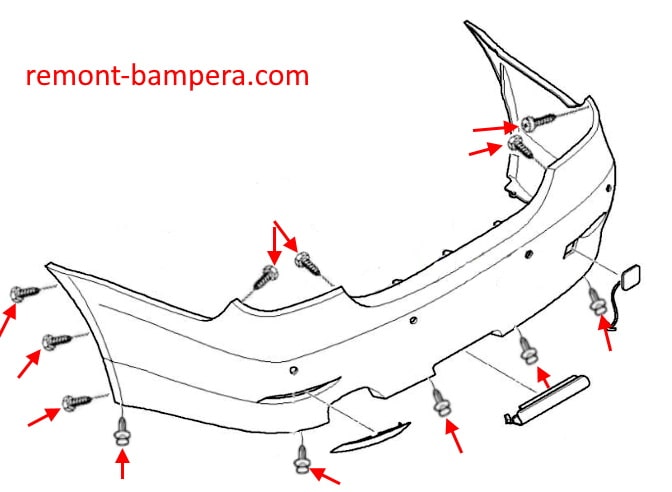
- (E60 Sedan): Remove the side trunk trim panels and unscrew the two bolts behind each panel (left and right).
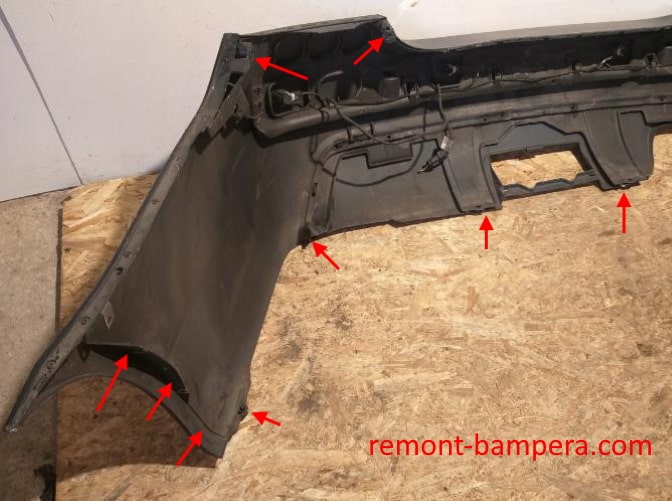
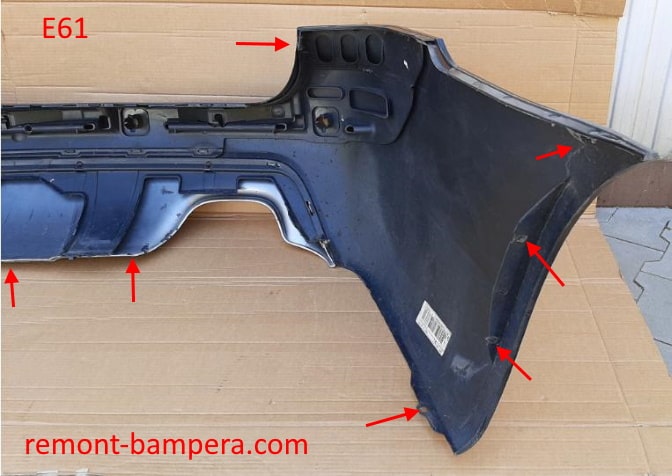
(E61 Touring): Unscrew the two bolts inside the trunk opening. - In the wheel arches, unscrew the four (three) bolts on each side that secure the wheel arch liners and the sides of the bumper.
- From the underside/underbody, remove the five clips inserted from bottom to top.
- Release the clips in the fenders by pulling the bumper corners towards you by hand.
- With an assistant, carefully pull the bumper backward and disconnect the connectors for the parking assistance system (if equipped).


Model advantages
- Handling and chassis: Incredibly sharp, precise, and rear-wheel-drive handling. The suspension, even in comfort-oriented versions, provides an ideal balance between cornering stability and ride smoothness.
- Interior and technology: High-quality materials, ergonomic driver's environment. First application of iDrive with a central console screen in the midsize class. The system was significantly improved after the facelift.
- Breadth of the model range: From economical diesels to the "super-sedan" M5, allowing buyers to choose a car for any need.
- Design: Over time, Chris Bangle's controversial design is now recognized as bold and progressive, defining the brand's design language for a decade.
Disadvantages and common issues
- Electromechanical power steering (EPS): The first generation of the system (so-called "Active Steering" with variable ratio) is prone to failures (Servotronic). The standard EPS (without variable ratio) is more reliable, but many enthusiasts miss the classic "mechanical" steering feel.
- Electronics reliability: The complex electronic architecture (CAN, MOST buses) is sensitive to voltage spikes. Possible malfunctions in iDrive, instrument cluster, and comfort systems.
- Engine-specific issues:
- Petrol N4x (e.g., N46 2.0L): Issues with VANOS (variable valve timing) system, valve stem seals.
- Petrol N5x (e.g., N52 3.0L): Unfortunate magnesium-aluminum engine block, issues with thermostat, water pump, and variable intake manifold (DISA) system.
- Diesel M57: Failure of piezo-type fuel injectors, diesel particulate filter (DPF) on high-mileage cars, dual-mass flywheel.
- Corrosion: While the galvanized body of the E60 is generally resistant, early models (pre-2005) may develop corrosion spots on sills, wheel arches, and trunk lid.
Interesting facts
- The E60 M5 was the first (and so far last) sedan from the M division with a naturally aspirated V10 engine, borrowed from the BMW supercar (the S85 was developed for the M5/M6). Its 7-speed SMG III transmission was a subject of both admiration (shift speed) and criticism (abruptness in city driving).
- It was in this generation that technologies such as Adaptive Headlights, Head-Up Display, Night Vision, and Active Cruise Control debuted for the 5 Series.
Italiano
Français
русский
English
Deutsch
Español