Production Years: The E46 series was produced from 1998 to 2006 for the European and global markets. It's important to note that production for certain markets (e.g., the sedan in South Africa) may have continued slightly longer, but the main production for Europe ended in 2006 with the arrival of the E90 model.

Body Types: BMW offered a variety of body styles, characteristic of that era:

  • Sedan (4-door) – the base model, launched first in 1998.
  • Coupe (2-door) – introduced in 1999, often sold as the "Coupé".
  • Wagon (Touring) – the practical version, from 1999.
  • Convertible (Cabrio) – with a soft folding top, from 2000.
  • Hatchback (Compact) – 3-door, with a unique rear section, from 2001 (facelift version).


Key Technical Specifications (example of mass-produced engines):

  • Engines: A wide range of petrol and diesel engines. From the 1.8-liter 4-cylinder (116 hp, N42) to the legendary inline 6-cylinder 3.2-liter (S54B32) in the M3 version (343 hp). Diesel engines (M47, M57) with 2.0 and 3.0-liter displacements were renowned for their fuel efficiency and torque.
  • Transmission: 5- or 6-speed manual, 4- or 5-speed automatic (Steptronic), and the M3 featured the SMG robotic gearbox.
  • Platform: Rear-wheel drive (all-wheel drive xDrive was offered for some modifications after the 2001 facelift).
  • Suspension: Independent multi-link rear suspension (Z-shaped link), providing excellent handling.


Bumper plastic marking: >PP+EPDM<.


Note: Depending on the year of manufacture and model, mounting points may vary slightly.

How to Remove the Front Bumper

  1. Open the hood.
  2. Turn the front wheels fully to the left or right, depending on which side you are starting from. In the wheel arches, remove the screws that secure the fender liners to the bumper.
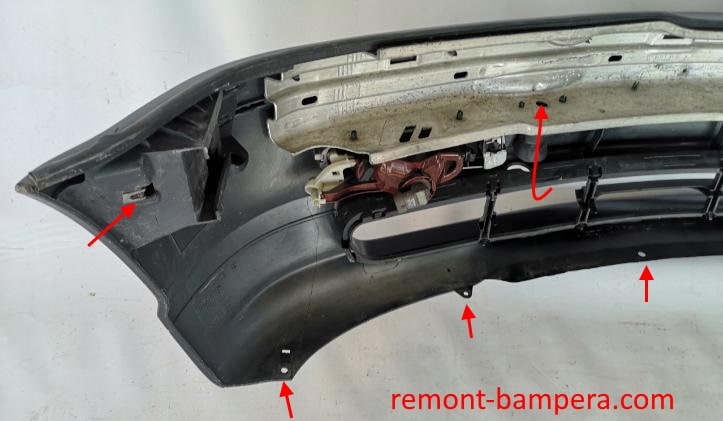
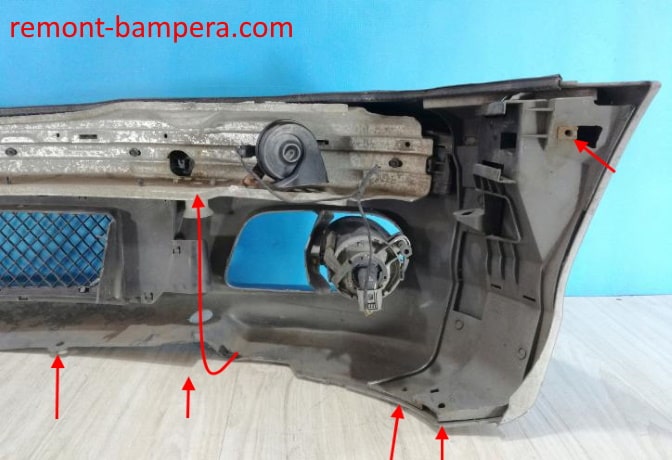
  3. Remove the screws (clips) from underneath the car (fastened from bottom to top).
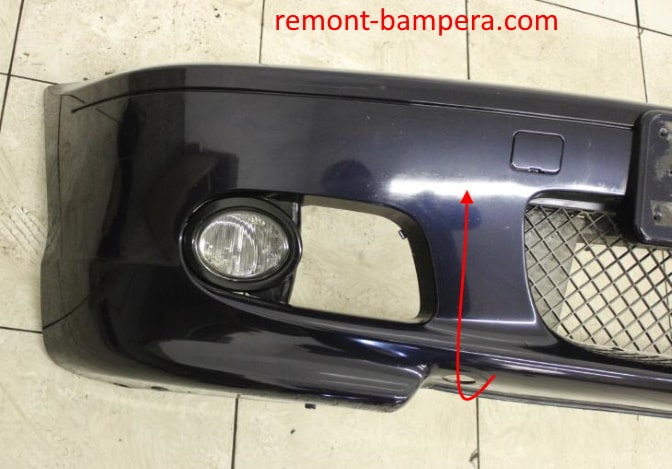
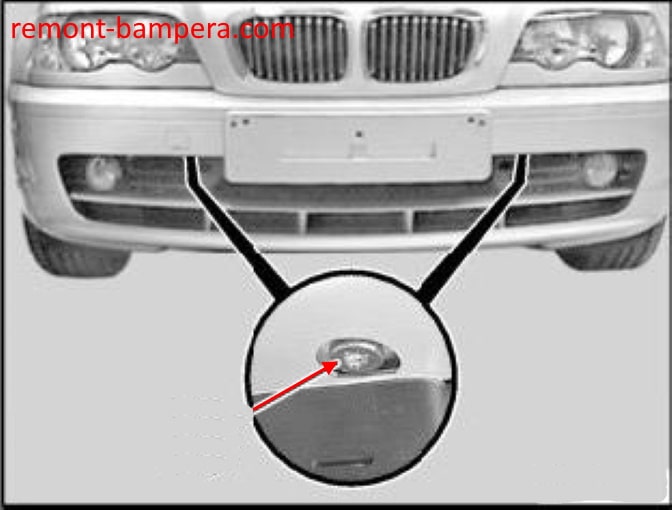
  4. Through special access holes, remove the two bolts (fastened from bottom to top) that secure the bumper reinforcement bar to the shock absorber brackets. Depending on the model, these holes are located in the lower radiator grille or in the lower part of the bumper (an extension and ratchet will be needed).
  5. Pull the edges of the bumper towards you and slide it forward off the guide brackets in the fenders (easier with an assistant).
  6. Disconnect the electrical connectors for the fog lights (if equipped).

BMW 3 Series E46 front bumper mounting locations

BMW 3 Series E46 front bumper mounting locations

BMW 3 Series E46 front bumper mounting locations

BMW 3 Series E46 front bumper mounting diagram


How to Remove the Rear Bumper

⇒Useful tips on how to remove the bumper and not break anything.⇐

  1. In the wheel arches, remove the screws that secure the fender liners to the bumper.
  2. Remove the screws from underneath that secure the underbody protection (if equipped).
  3. Next, there are two possible methods:
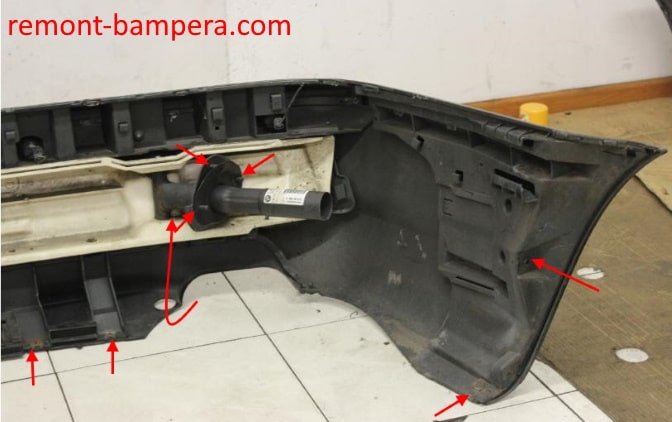
    • From under the car, through special access holes, remove the two long bolts that secure the bumper reinforcement brackets to the impact absorbers (crash cans). You will need a Torx T50 key and an extension.
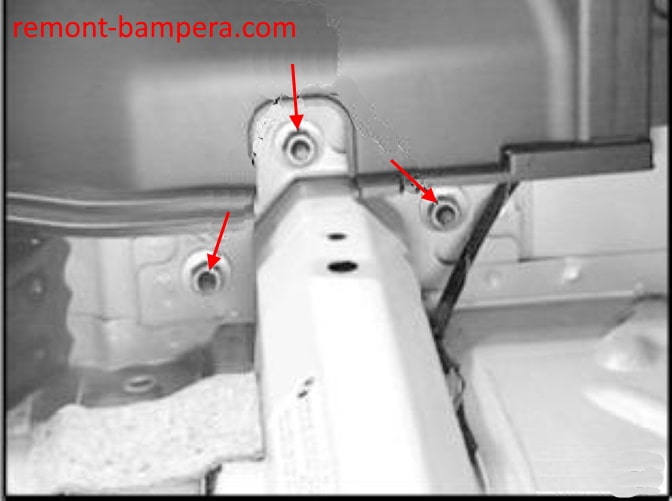
    • Remove the trunk interior trim panel on the rear wall. Behind it, unscrew the six nuts that secure the impact absorbers to the body.
  4. With an assistant, evenly pull the bumper straight back to disengage it from the guide brackets in the fenders.
  5. Disconnect any electrical connectors.

BMW 3 Series E46 rear bumper mounting locations

BMW 3 Series E46 rear bumper mounting diagram


Interesting Facts About the Model:

  • The E46 was the first 3 Series offered exclusively with a unibody (integrated) chassis structure.
  • The M3 CSL version (2003-2004) was a lightweight (by 110 kg), high-powered (360 hp) track-focused version with a carbon fiber roof and specific body kit. Its S54 engine was named "Engine of the Year" several years in a row.
  • The E46 Convertible was the first BMW 3 Series to feature a fully electro-hydraulic folding top mechanism, eliminating the need to manually secure latches.
  • The iDrive multimedia system debuted and gained popularity on the E46, but only in top trim levels after the facelift.


Strengths:

  • Outstanding Handling: An ideal balance of body rigidity, steering precision (hydraulic power steering), and well-tuned suspension. A benchmark in its class.
  • Reliable Inline 6-Cylinder Petrol Engines: The M54 series engines (2.2, 2.5, 3.0L) are known for their durability and smooth operation with proper maintenance.
  • High-Quality Interior Materials: For its time – a high level of finish, pleasant-to-the-touch materials (especially in pre-facelift models).
  • Timeless Design: Harmonious proportions that have become a classic, standing the test of time.

Weaknesses and Common Issues:

  • Prone to Rust: Especially in rear wheel arches, rocker panels, and shock absorber mounting points. The quality of galvanization on early production batches was insufficient.
  • Cooling System Problems: Plastic components (thermostat, water pump housing, expansion tank) become brittle and fail after approximately 100,000 km, requiring preventive replacement.
  • Clogged Crankcase Ventilation System (CCV): On M54 engines, leads to increased oil consumption and leaks.
  • Wear of Rear Bushings on Front Control Arms (Meyle HD part recommended): Causes instability at high speed and accelerated tire wear.
  • Rear Multi-Link Suspension: Requires expensive repairs when its numerous ball joints and rubber bushings wear out.