The third generation of the Lexus IS was introduced in 2013. The model, known under the body index XE30, underwent several significant updates and offered a wide range of powertrains, including both gasoline and hybrid versions.
Model Years and Evolution
- First Facelift (2013–2016): The generation debuted at the Detroit Auto Show in 2013. The car featured a bright, aggressive design with a recognizable "hourglass" front end. The model range included the IS 250, IS 350, and the hybrid IS 300h.
- Second Facelift (2017–2020): In 2017, the model underwent a serious update. It received a radically redesigned front end with new headlights and a new radiator grille, updated rear optics, and a modernized multimedia system.
- Third Facelift (2021–2025): The latest update in 2021 brought an even more striking design inspired by the flagship LS, including a huge radiator grille and new LED headlights. It was in this update that the legendary IS 500 F Sport Performance version with a naturally aspirated V8 debuted for the North American market.
Main Powertrains:
- IS 200t / IS 300 (2.0L Turbo): For many markets, this was the base engine. The 2.0-liter turbocharged inline-four (8AR-FTS) produced about 245 hp. Later, in some markets, including North America, this same powertrain was offered under the IS 300 index.
- IS 250 / IS 300 (2.5L V6): A 2.5-liter naturally aspirated V6 (4GR-FSE) with about 208 hp. It was popular in Russia and a number of other countries. After the facelift, in some markets, the model with this engine also began to be called IS 300.
- IS 350 (3.5L V6): The flagship version until the IS 500 appeared. The 3.5-liter V6 (2GR-FSE) produced 315 hp and was paired with an 8-speed automatic transmission. This was the most dynamic variant in the lineup for most of the model's life cycle.
- IS 300h (2.5L Hybrid): Equipped with a hybrid system based on a 2.5-liter gasoline engine (2AR-FSE) and an electric motor. Total system output was about 223 hp. Main advantages are high fuel efficiency and smooth ride.
- IS 500 F Sport Performance (5.0L V8): The "star" of the last facelift. Featured a naturally aspirated 5.0-liter V8 (2UR-GSE) with 472 hp. It was a tribute to tradition and the only sedan of its kind in the class with a naturally aspirated V8.
Bumper Plastic Marking: >PP+E/P-TD20<
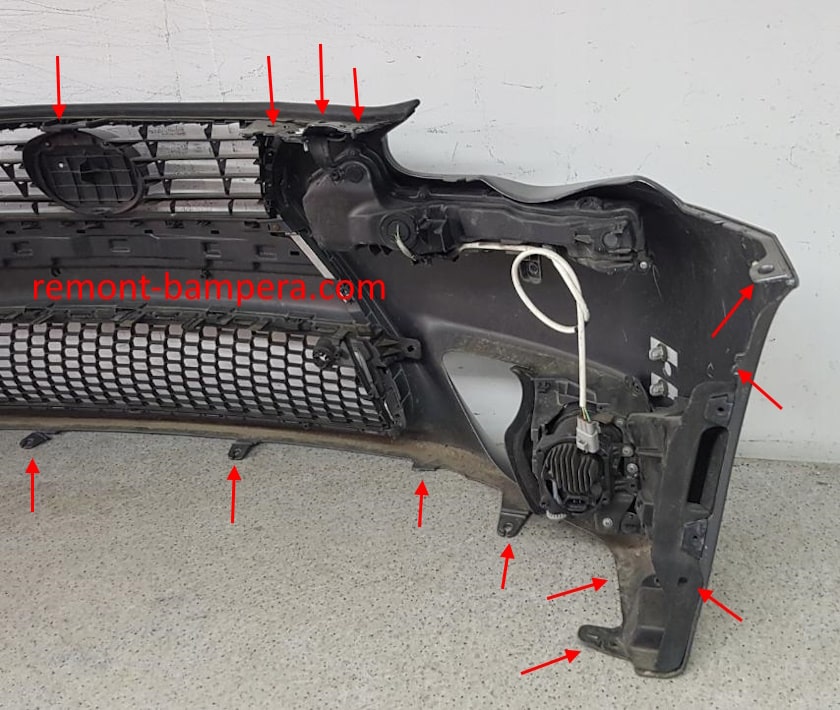
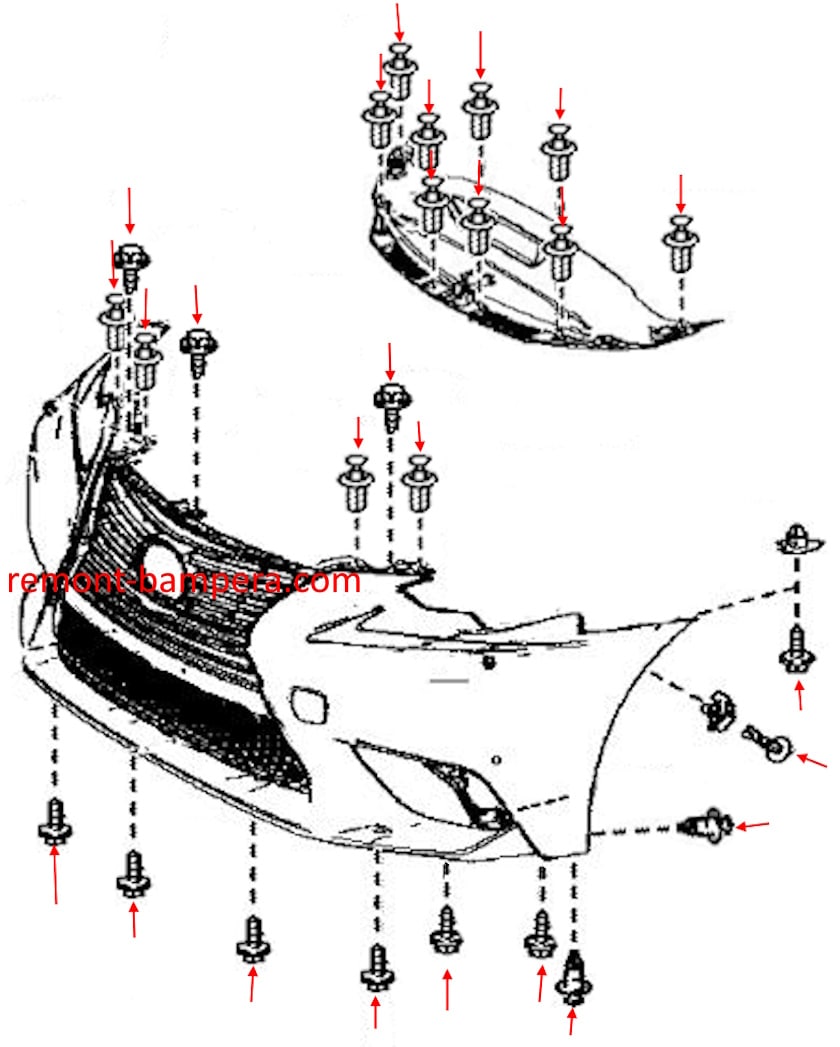
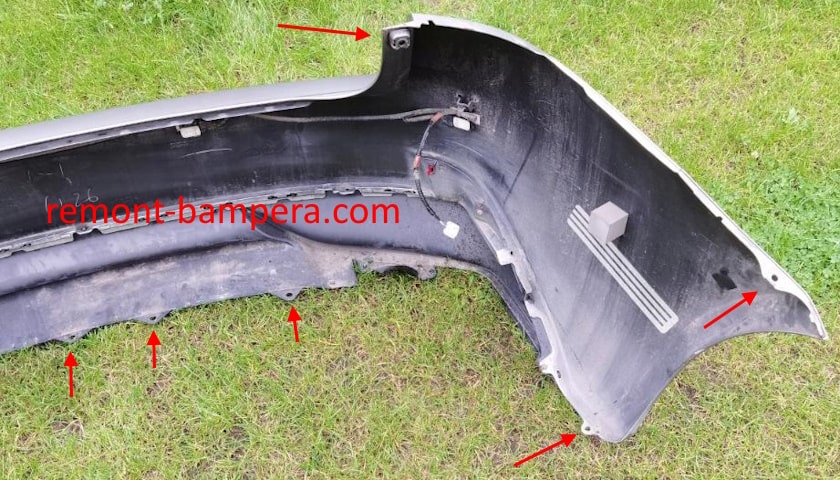
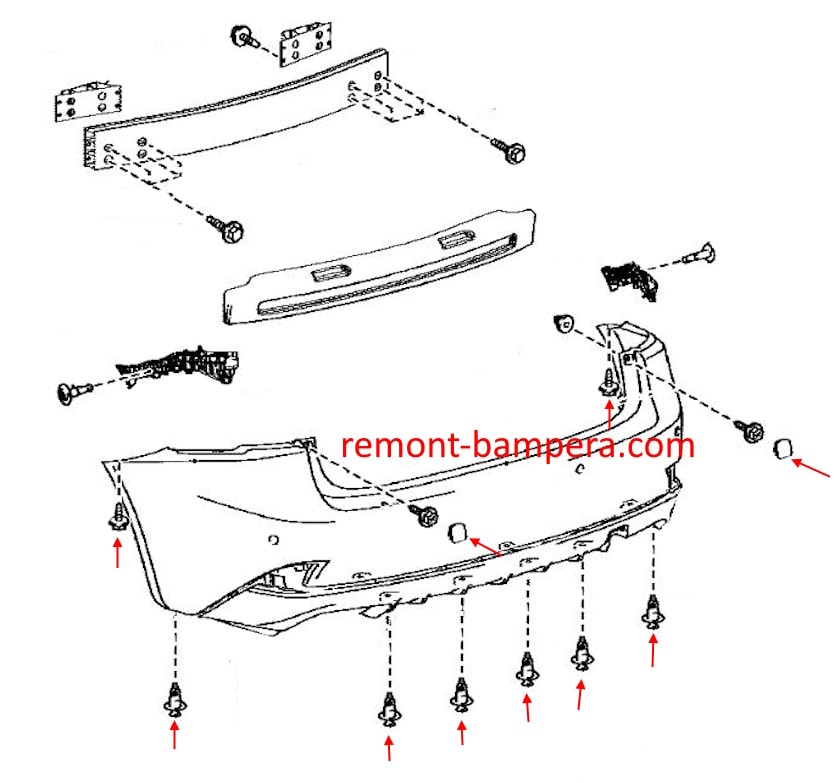
Depending on the year of manufacture, the mounting points may differ.
How to Remove the Front Bumper
- Open the hood.
- Under the hood, remove nine plastic clips (inserted from top to bottom) and remove the plastic cover.
- Under the cover, remove four plastic clips and unscrew three screws that secure the top of the front bumper and the radiator grille.
- (If present) On the back side of the radiator grille, disconnect the electrical connector.
- Around the perimeter of the lower part, unscrew eight screws and remove two plastic clips (screwed and inserted from bottom to top).
- Turn the wheels to the side, depending on which side you are working on.
- In the wheel arches, remove the plastic clips and release the fasteners that hold the front part of the wheel arch liners.
- Move the wheel arch liners aside and unscrew one screw on each side (screwed from bottom to top) that secure the corners to the fenders.
- Release the clips in the fenders (pull the corners towards yourself).
- Release the clips under the headlights.
- With an assistant, carefully pull the bumper forward (watch for wires).
- Disconnect the electrical connectors.


How to Remove the Rear Bumper
- Open the trunk lid.
- In the trunk opening, remove two plugs (carefully pry with a flat tool).
- Under the plugs, unscrew two screws that secure the top of the rear bumper.
- From under the car, remove six plastic clips (inserted from bottom to top) that secure the lower part.
- In the wheel arches, free the rear part of the wheel arch liners.
- Move the wheel arch liners aside and unscrew one screw on each side (screwed from bottom to top) that secure the corners to the fenders (a 10mm socket with an extension will be needed).
- Release the clips in the fenders (pull the corners towards yourself).
- With an assistant, pull the bumper backward (watch for wires).
- Disconnect the electrical connectors.


Interesting Facts About the Model:
- The IS 500 version is the successor to the iconic IS F model and is positioned not as a full-fledged sports car, but as a "quiet super sedan" with a characteristic V8 sound.
- The interior of the third-generation IS was criticized for its outdated design and the use of the Remote Touch touchpad for multimedia control, especially compared to modern systems from competitors. However, the quality of the interior materials always remained at the highest level.
- Although the platform was considered outdated by the time of the last facelift, Lexus engineers managed to maintain competitive driving dynamics through subtle adjustments to the suspension and chassis.
Advantages and Disadvantages
Advantages:
- Reliability: Lexus traditionally leads in reliability ratings. The GR and UR engine series, as well as the transmissions, are known for their durability.
- Build Quality and Materials: Impeccable interior build quality, the use of expensive and pleasant-to-the-touch materials.
- Comfort and Smooth Ride: Even in the F Sport versions, the IS provides a high level of comfort.
- Bright, Memorable Design: Especially after the facelifts, which made the car stand out in traffic.
- Uniqueness of the IS 500: The last of its kind with a naturally aspirated V8 in the class of compact sports sedans.
Disadvantages:
- Outdated Platform: Compared to main competitors (BMW 3-Series, Mercedes-Benz C-Class), the chassis and overall vehicle architecture were not modern.
- Interior and Multimedia: Even after updates, the multimedia system and interior design lagged behind the times.
- Fuel Economy of Naturally Aspirated Engines: Versions with V6 and especially V8 engines had high fuel consumption compared to the turbocharged engines of rivals.
- Limited Rear Seat Space: Compared to some classmates, the cabin was more cramped.
Italiano
Français
русский
English
Deutsch
Español