Production Years:
The second-generation Chrysler 200 debuted in 2014 as a 2015 model year vehicle. Production ceased in December 2016, although remaining inventory was sold as 2017 models.
Engine Lineup:
- Base 2.4-liter (Tigershark MultiAir 2). Produced 184 horsepower and 232 Nm of torque. This was a workhorse but noisy engine that liked high revs.
- Top-tier 3.6-liter V6 (Pentastar). Delivered 295 hp and 354 Nm. This legendary engine was used in pickups and minivans, but here it was tuned to its maximum output.
Both engines were paired exclusively with a 9-speed automatic transmission, the ZF 948TE.
Bumper Plastic Marking: >TEO<
How to Remove the Front Bumper
- Open the hood.
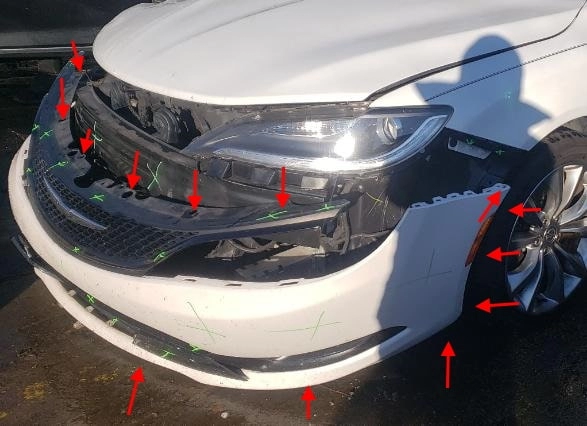
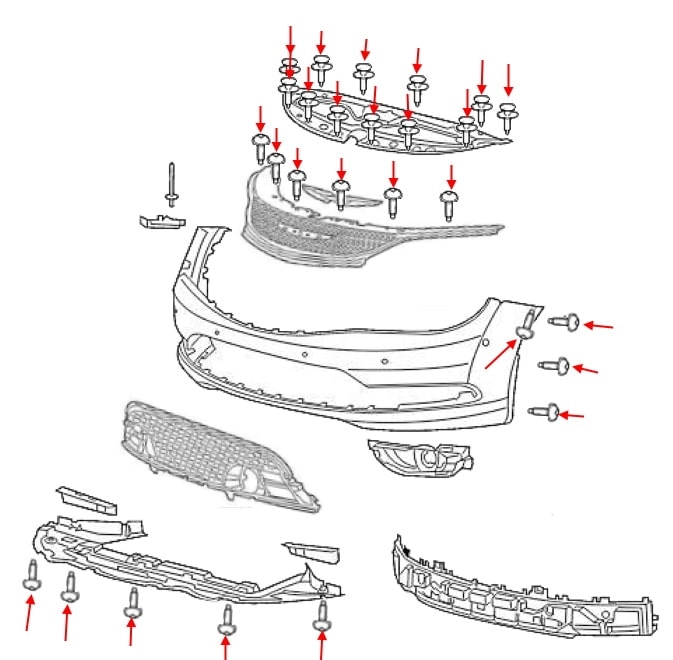
- Under the hood, remove twelve clips and take off the plastic shield.
- Under the shield, unscrew six bolts that are screwed in from top to bottom and secure the upper part of the front bumper.
- Move to the lower part and unscrew six bolts that are screwed in from bottom to top.
- Turn the front wheels inward toward the wheel arches one at a time.
- On the left and right sides, unscrew three bolts each that secure the fender liners to the bumper.
- Pull the fender liners aside and unscrew one bolt on each side (left and right) that secure the bumper corners to the fenders.
- With a sharp tug, pull the corners toward you to release the clips in the fenders.
- Release the clips under the headlights by simply pulling toward you.
- With an assistant, pull the bumper forward and disconnect the main electrical connector.


How to Remove the Rear Bumper
- Open the trunk lid.
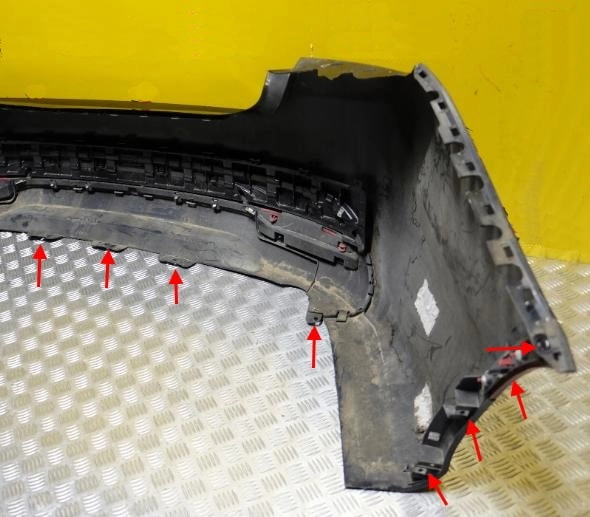
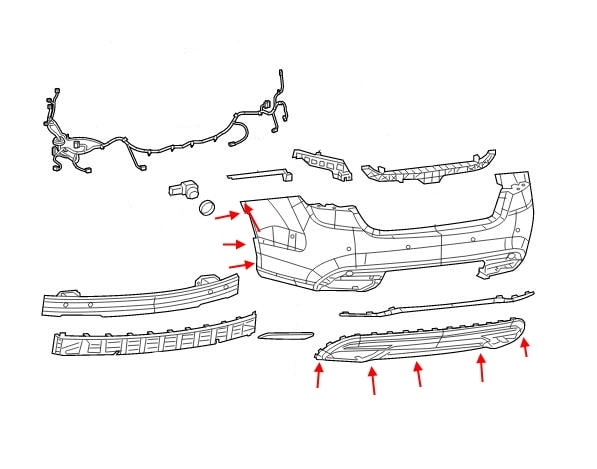
- Get under the vehicle and unscrew six bolts that are screwed in from bottom to top and secure the lower part of the rear bumper.
- In the wheel arches, unscrew three bolts on each side (left and right) that secure the fender liners to the bumper.
- Pull the fender liners aside and unscrew one bolt on each side (left and right) that are screwed in from bottom to top and secure the bumper corners to the fenders.
- Release the clips in the fenders by sharply pulling the bumper corners toward you.
- Release the clips under the rear taillights.
- With an assistant, pull the bumper rearward and remove it.


Interesting Facts About the Model:
- Design. The drag coefficient was just 0.28 Cd — the best in its class at the time of release.
- Touchscreen Panel. Top versions featured an 8.4-inch screen that was a true breakthrough: it supported swipe gestures like a smartphone and even allowed seat heating to be controlled through the menu.
- Rotary Gear Selector. Instead of a traditional lever, a round dial was used, which recessed into the center console.
- Cylinder Deactivation System. The V6 could shut down one bank of cylinders during highway driving, saving up to 15% fuel on the road.
Pros:
- Design and Noise Insulation. It was one of the most beautiful sedans of its time, with an aggressive coupe-like profile. Noise insulation was a head above the Toyota Camry or Honda Accord.
- Suspension and Handling. The handling was balanced and comfortable. The car tracked straight beautifully and didn't lean in corners, thanks to the stabilizer bars.
- Rich Features. For the price, it offered ventilated seats, a premium Harman/Kardon sound system, and all-wheel drive.
Cons:
- Transmission. The 9-speed ZF turned out to be "green" — it constantly hesitated and stumbled during 1st-to-2nd gear shifts.
- Material Quality. Despite the gorgeous design, cheap hard plastic on the doors and center console immediately revealed its budget origins.
- Visibility. Due to the sloping roofline and high rear window, visibility was terrible, and the rear seats were not generous with legroom for tall passengers.
Italiano
Français
русский
English
Deutsch
Español