Model Years:
1994–1999
The first-generation Chrysler Neon (factory index PL) entered production in early 1994 as a 1995 model-year vehicle. Production continued through 1999. Over the course of six years, approximately 2.7 million units were produced worldwide.
Engines:
- SOHC — The standard engine for all trim levels. Power output: 132 hp at 6,000 rpm, torque: 175 N·m at 5,000 rpm.
- DOHC — The sportier version, introduced in 1995. Power output: 150 hp at 6,500 rpm, torque: 180 N·m.
- 2.4-liter DOHC — A 2.4 L engine sourced from the Dodge Stratus. Power output: 140 hp, but with higher torque: 210 N·m.
How to Remove the Front Bumper
- Open the hood.
- Under the hood, unscrew the screws and remove the radiator grille.
- For easier access, turn the wheels to one side.
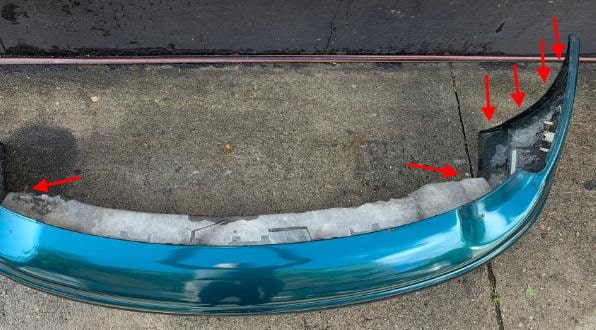
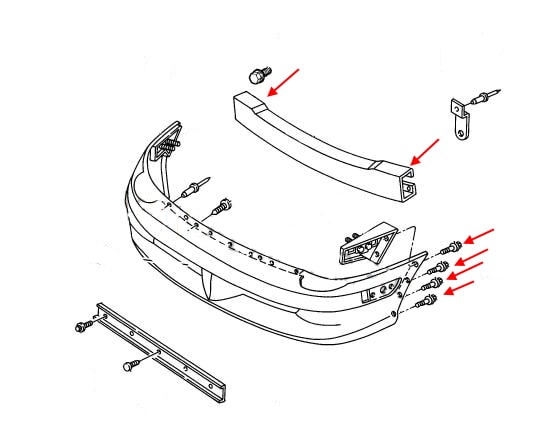
- In the wheel arches, unscrew four screws on the left side and four on the right side that secure the side sections of the bumper.
- From the engine bay side, unscrew the nuts that attach the bumper reinforcement bar to the body.
- With an assistant, release the bumper from the guide rails in the fenders and pull it forward (watch out for wiring).
- Disconnect any electrical connectors (if equipped).


How to Remove the Rear Bumper
- Open the trunk lid.
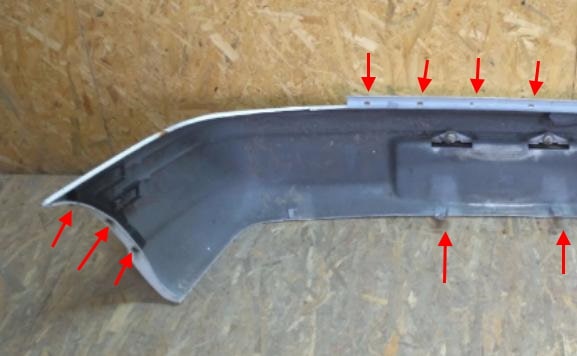
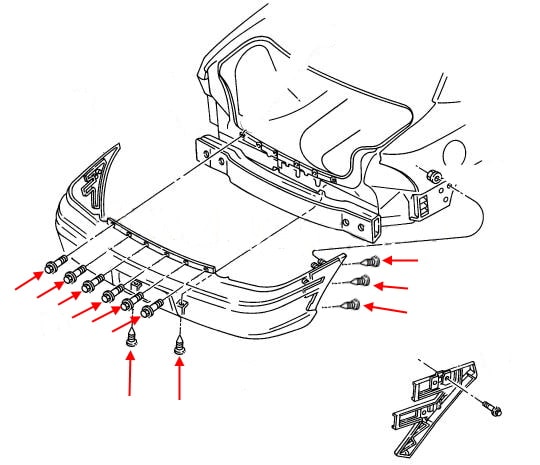
- Inside the trunk opening, unscrew the six screws that secure the upper section of the rear bumper.
- In the wheel arches, unscrew three screws on the left side and three on the right side that secure the sides of the bumper.
- Unscrew the two screws from the underbody side (these are screwed in from the bottom upward).
- With an assistant, pull the bumper off toward the rear and disconnect any electrical connectors.


Interesting Facts:
- The Neon I body had a drag coefficient of Cx = 0.33 — an excellent figure for the mid-1990s. The "bubble" shape was born out of the need to accommodate a tall driver while keeping the hood line low.
- The SOHC engine featured an economical mode. Under partial loads, the engine control unit leaned out the air-fuel mixture to 17:1, allowing fuel consumption as low as 6.5 L/100 km.
- The Neon ACR is not an options package but a homologation special. ACR (American Club Racer) was created specifically for amateur SCCA racing. It came with upgraded springs, stiffer shock absorbers, a larger sway bar, four-wheel disc brakes (instead of rear drums), and a mandatory DOHC engine.
- In 1996, the Neon became the first in its class to offer a cabin air filter with activated charcoal — an option that was considered premium at the time.
Advantages:
- With an overall length of 4,360 mm, the wheelbase measured 2,640 mm — longer than that of the first-generation Ford Focus. Three adults could sit in the rear without feeling cramped.
- The front suspension with control arms and the rear torsion-beam axle, combined with gas-filled shock absorbers, provided stable straight-line tracking on the highway and predictable oversteer in corners.
- The cast-iron engine block and forged steel crankshaft gave a service life of 280,000–320,000 km before major overhaul, provided oil was changed on time (interval: every 7,500 km).
- Low cost of spare parts (still the case in the US and Europe).
Disadvantages:
- Cylinder head (especially DOHC). On DOHC engines, the head gasket often failed due to the thin wall between cylinders.
- Corrosion of rear wheel arches. The factory anti-corrosion coating was thin, and in regions where roads are salted, the arches would rust within 5–6 years.
- Automatic transmission. The 3-speed 31TH is reliable, but it tends to overheat in heavy traffic. Torque converter failure is a common issue after 150,000 km.
- Sound insulation is minimal: at 120 km/h, interior noise levels reach 74 dB, which can be tiring.
- The dashboard would squeak in freezing temperatures, and the air conditioning buttons would lose their markings within just two years.
Italiano
Français
русский
English
Deutsch
Español