Production Years and Characteristics:

The Alfa Romeo 147 was produced from 2000 to 2010. It replaced the legendary 145/146 model and marked an important step for the brand, reintroducing an elegant compact hatchback to its lineup. In 2004, the model underwent a major facelift that affected the exterior, interior, and technical components. An interesting fact: just one year after its debut, in 2001, the 147 won the "European Car of the Year" title, beating strong competitors like the Ford Mondeo and Renault Laguna.


Technical Specifications (Main Engines)

The model was offered with a wide range of engines, which was its key advantage.

Petrol:

  • 1.6 Twin Spark (120 hp) — the base engine, with two spark plugs per cylinder for better combustion.
  • 2.0 Twin Spark (150 hp) — the most popular and well-balanced option.
  • 2.0 GTA (250 hp) — the performance version from the Alfa Romeo Sport division. It featured a 3.2-liter Busso V6 engine (the "2.0" in the name was initially a marketing move), which is legendary among brand enthusiasts for its unique sound and character.

Diesel (JTD with Common Rail system):

  • 1.9 JTD (8v — 105 hp, 16v — 140 hp) — economical and torque-rich. The 16-valve 1.9 JTD 16v was particularly good.
  • 2.4 JTD (150 hp) — a 5-cylinder engine offering high torque.

Transmissions: 5- and 6-speed manuals, as well as the Selespeed robotic gearbox (with hydraulic clutch and gearshift actuation) for the 2.0 TS and GTA. Drivetrain: exclusively front-wheel drive.

Suspension: Front — independent MacPherson strut, rear — dependent torsion beam. However, a multilink rear suspension was installed on the GTA version and, after the facelift, on some 2.0 trim levels.


Bumper Plastic Marking: >PP-TD10<


Depending on the production year, the mounting points may vary slightly.

How to Remove the Front Bumper

  1. Open the hood.
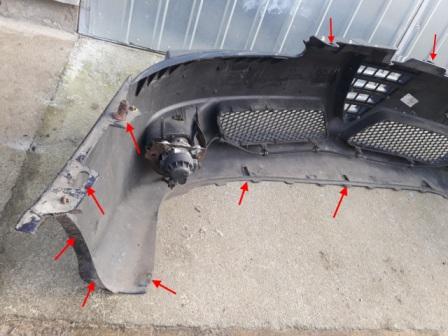
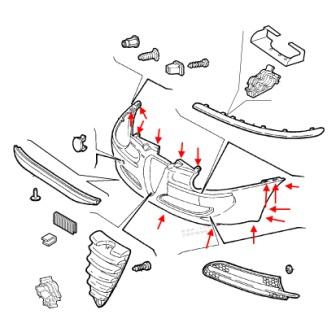
  2. Unscrew the four screws (fastened top-to-bottom) that secure the top part of the front bumper.
  3. Move to the lower part and unscrew the five screws (fastened bottom-to-up).
  4. In the wheel arches, unscrew the screws and detach the wheel arch liners from the bumper.
  5. Move the liners aside and unscrew the four screws (two on the left and two on the right side, fastened bottom-to-up) that secure the sides to the fenders.
  6. With an assistant, remove the bumper by pulling it forward, being careful with wires and hoses.
  7. (If installed) Disconnect the headlight washer hoses and the fog light power connectors.

Alfa Romeo 147 front bumper mounting locations

Alfa Romeo 147 front bumper mounting diagram


How to Remove the Rear Bumper

⇒Useful tips on how to remove the bumper and not break anything.⇐

  1. Open the tailgate.
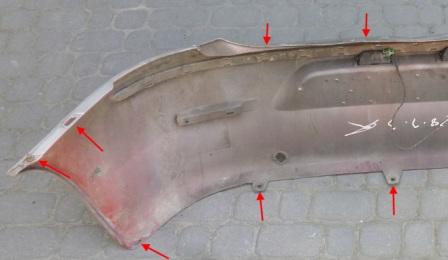
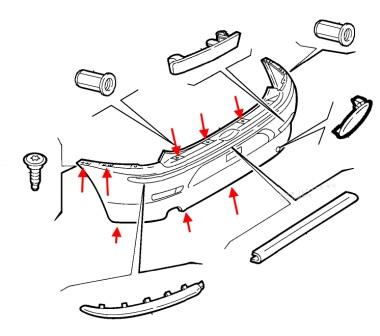
  2. In the trunk opening, unscrew the four screws (fastened top-to-bottom) that secure the top part of the rear bumper.
  3. Go to the lower part and unscrew the five screws from under the car.
  4. In the wheel arches, unscrew the screws and detach the wheel arch liners from the bumper.
  5. Pull the liners aside and unscrew the two screws on the left and right sides (fastened bottom-to-up).
  6. With an assistant, remove the bumper by pulling it backward. Disconnect the license plate light connectors and (if installed) the parking sensor connector.

Alfa Romeo 147 rear bumper mounting locations

Alfa Romeo 147 rear bumper mounting diagram


Model Advantages

  • Unmatched Design and Emotion: Unique, expressive Italian style, especially in the pre-facelift version with "teardrop" headlights. Emotional engine sound, particularly from the V6.
  • Excellent Handling: Sharp, precise steering (rack and pinion with power steering) and balanced suspension provided genuine driving pleasure.
  • High-Quality Interior: For its class — excellent materials, sporty seating position. The three-spoke steering wheel and "teardrop" instrument clusters became iconic.
  • Wide Range of Engines: From economical diesels to the spectacular atmospheric V6.

Disadvantages and Issues

  • Reliability and Electronics: A characteristic "Italian" ailment. Possible issues with sensors, wiring, and the engine control unit (ECU). The Selespeed robot requires careful maintenance and is often problematic.
  • Rust: The body, especially sills, wheel arches, trunk lid, and suspension components, is prone to corrosion. Requires thorough inspection.
  • Expensive Maintenance: Parts are more expensive than those of mass-market competitors. Complex solutions (like the Selespeed) require specialist knowledge.
  • Tight Rear Seats and Trunk: Practicality was compromised for the sake of design.


Conclusion

The Alfa Romeo 147 is a car for the heart, not for practical calculation. It offered a unique mix of emotional design, thrilling handling, and melodious engines, standing out among its "bland" classmates. However, this charisma came at the cost of requiring attentive maintenance and readiness for higher upkeep expenses. Today, the 147, especially versions with the Busso V6 engine, is already a cult car, and its price on the secondary market is beginning to rise.