Production Years:

  • The first Cadillac XTS rolled off the assembly line in 2012, and the final versions left the factory in Detroit in 2019.
  • Facelift (2017 model year): The point-type LED daytime running lights in the headlights were replaced with full-fledged LED headlights featuring complex graphics. The grille was redesigned, adding horizontal chrome inserts instead of the mesh, and new 19-inch alloy wheels were installed. However, the biggest changes happened inside: the XTS received a new second-generation CUE (Cadillac User Experience) multimedia system with a diagonal screen increased to 8 inches and a shift from physical buttons to capacitive touch panels.


Engines:

Unlike its predecessors, the XTS completely abandoned naturally aspirated V8s. The base and only engine became the 3.6-liter V6 from the LFX series (later LGX) with direct fuel injection and variable valve timing on both intake and exhaust. Its power varied depending on the year and market, ranging from 304 to 318 horsepower. For China and some European markets, a version with a 2.0-liter turbocharged LTG engine producing 269 hp was offered.


Bumper Plastic Marking: >TPO<


Depending on the year of manufacture, the mounting points may vary slightly.

How to Remove the Front Bumper

  1. Open the hood.
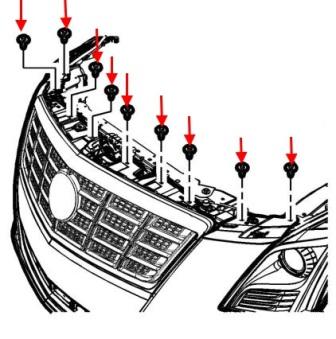
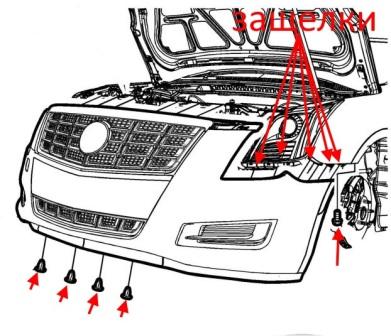
  2. Pull upward to release the latches and remove the radiator sight shield (upper cover).
  3. Under the shield, unscrew the ten screws that are fastened from top to bottom and secure the upper part of the front bumper (the grille area).
  4. Move to the lower part. From underneath the vehicle, unscrew ten screws and remove four clips.
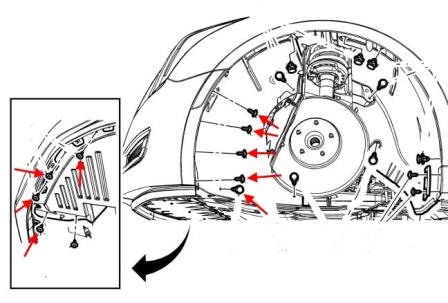
  5. Now, in the wheel arches, unscrew four screws on the left side and four on the right side that secure the fender liners to the bumper.
  6. Pull the fender liners aside and unscrew one screw on the left and one on the right side. These are fastened from bottom to top and secure the bumper corners to the fenders.
  7. With a sharp tug, using moderate force, pull the bumper corners towards you to release the latches in the fenders.
  8. With an assistant, pull the bumper forward to remove it and disconnect the electrical connectors.

Cadillac XTS front bumper mounting locations

Cadillac XTS front bumper mounting diagram


How to Remove the Rear Bumper

⇒Useful tips on how to remove the bumper and not break anything.⇐

  1. Lift the trunk lid.
  2. Get under the vehicle. Unscrew two screws and remove four clips that are fastened and inserted from the bottom up.
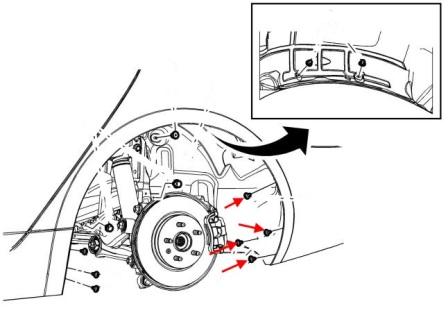
  3. In the wheel arches, unscrew four screws on the left side and four on the right side that secure the fender liners to the bumper.
  4. Pull the fender liners aside and unscrew one screw on the left and one on the right side that secure the corners to the fenders.
  5. Release the latches in the fenders by pulling the corners towards you with a sharp tug.
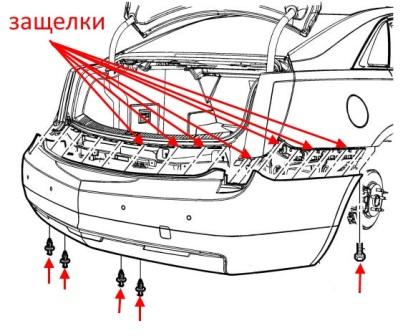
  6. Release the latches inside the trunk opening.
  7. With an assistant, pull the bumper backward to remove it and disconnect the electrical connectors.

Cadillac XTS rear bumper mounting locations

Cadillac XTS rear bumper mounting diagram


Interesting Facts About the Model

  • Engineers designed the XTS with an aluminum hood and a composite trunk lid to shift the center of gravity towards the front axle by only 2% — an outstanding figure for the front-wheel-drive Epsilon II platform.
  • The rear suspension was equipped with air springs only in top trim levels, but even in base versions, hydraulic bump stops with progressive characteristics were used, making the compression stroke 15% softer than competitors.
  • The active safety system included radar cruise control capable of functioning down to a complete stop, and a night vision camera displayed images on the head-up display. However, the most unusual feature was the vibration motors in the seat cushions — they warned the driver of obstacles on the left or right by vibrating the corresponding gluteal muscle.


Advantages:

  • Phenomenal ride smoothness. The long wheelbase (2837 mm) and the work of the magnetic ride control shocks (in versions with this option) absorbed any road irregularities so well that rear passengers didn't even feel expansion joints on bridges.
  • Rear legroom was nearly a meter — allowing even basketball players to sit comfortably.
  • Sound insulation was so effective that at 120 km/h, the interior noise level did not exceed 63 dB.

Disadvantages:

  • During hard acceleration from a standstill, there was significant wheelspin, and the stability control system harshly cut engine power.
  • Fuel consumption in the city reached 16–17 liters per 100 km even on non-turbo versions, making operation expensive.
  • The bulky first-generation multimedia system (pre-facelift) suffered from lags, and the touch-sensitive buttons on the steering wheel required getting used to due to accidental presses.
  • The most serious design flaw is the timing chain drive. On LFX engines, the chain required replacement by 120,000 km due to stretching, and the cost of the procedure was comparable to an overhaul of the transmission.