Production Years
Overview
The Cadillac SRX II debuted in 2009 for the American market as a 2010 model. Production continued until 2016, when it was replaced by the XT5.
A facelift occurred in 2012 (for the 2013 model year). Externally, it is distinguished by LED daytime running lights, a new grille with a larger emblem (Cadillac removed the laurel wreath), and updated taillights. Inside, the updated CUE (Cadillac User Experience) multimedia system with touch-sensitive buttons appeared — innovative for 2012, but inconvenient in practice.
Engines:
- 3.0L (LF1) V6 (265–270 hp, 302 Nm). A base naturally aspirated engine with direct injection. Worked with a 6-speed automatic 6T70. Before the facelift (2010–2012), it often suffered from "sluggishness" during acceleration — fuel consumption of 15 L per 100 km with the performance of a 1990s sedan.
- 3.6L (LFX) V6 (308–318 hp, 358 Nm). Appeared after the 2013 facelift. This is a modernized "six" with an improved intake system and variable valve timing. Acceleration to 100 km/h – 7.4 seconds (compared to 9 seconds for the 3.0L). At the same time, fuel consumption (averaging 13 L) barely increased.
Transmission: Before the facelift – 6-speed automatic (6T70); from 2013 onwards – the same 6-speed unit, but with revised algorithms.
Bumper Plastic Marking: >TPO<
Depending on the year of manufacture, the attachment points may differ slightly.
How to Remove the Front Bumper
- Open the hood.
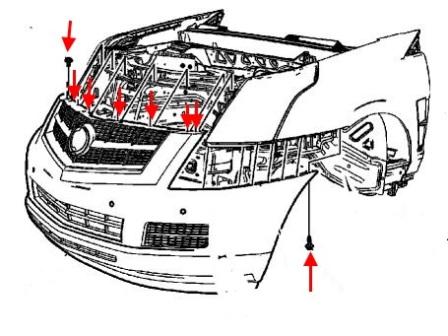
- Under the hood, remove the six clips that are inserted from top to bottom.
- Release the two inner clips (you need to pull them upwards) and remove the plastic shield.
- Unscrew the six screws that are threaded from top to bottom and secure the upper part of the front bumper.
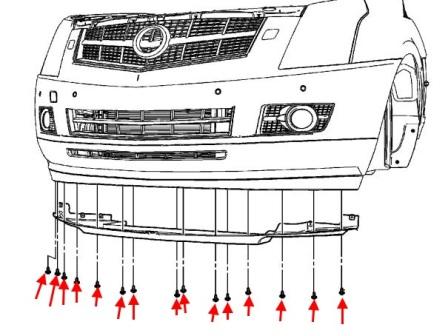
- Move to the lower part and unscrew the four screws (10 mm) that are threaded from bottom to top.
- Turn the steering wheel to the side.
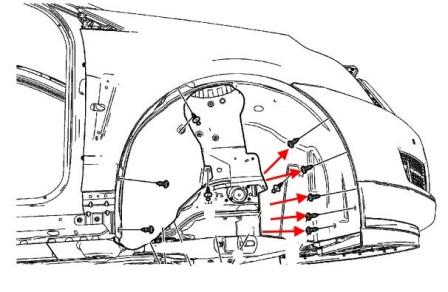
- In the wheel arches, unscrew five screws on the left and right sides that secure the fender liners to the bumper.
- Pull the fender liners aside and unscrew one screw on the left and right sides, which are threaded from bottom to top and secure the corners to the fenders.
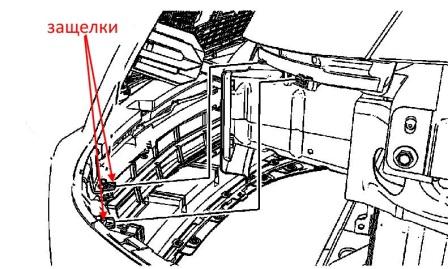
- Release the latches in the fenders; you need to pull sharply towards yourself.
- Release the fasteners under the hood; you need to pull them upwards.
- With an assistant, remove the bumper forward and disconnect the main electrical connector.
- Disconnect the hoses of the headlight washer system.


How to Remove the Rear Bumper
- Lift the tailgate upwards.
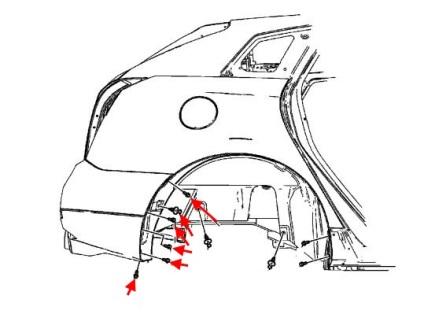
- In the wheel arches, unscrew three screws on the left and right sides that secure the fender liners to the bumper, and one screw on each side that secures the corners to the brackets in the fenders.
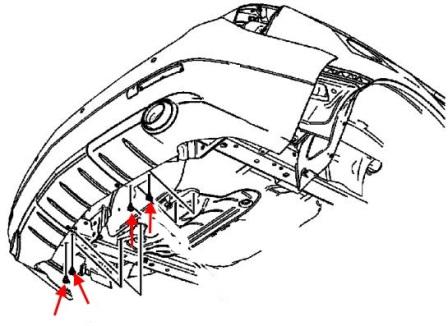
- From the underbody side, unscrew the six screws that are threaded from bottom to top.
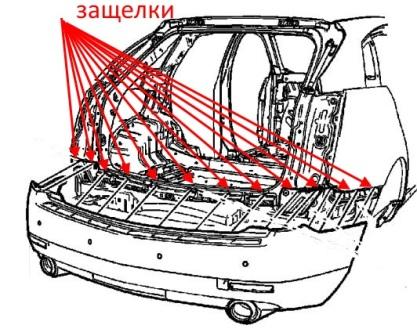
- Release the latches in the fenders; you need to pull sharply on the corners towards yourself.
- Release the latches under the rear lights and in the tailgate opening.
- With an assistant, remove the bumper towards the rear, watching for the wires.
- Disconnect the main electrical connector.


Interesting Facts about the Model
- UltraView Glass Roof. Optionally, a panoramic roof made of three sections was offered, which, when fully opened, turned the crossover into a kind of targa. Fact: This was the largest sunroof system in the premium crossover class at the time of its release.
- Pioneer of the CUE System. The 8-inch touchscreen with haptic feedback took engineers 2 years to develop. However, critics dubbed it an "exercise in patience": responses were slow, and the glossy surface collected fingerprints.
- Noise Cancellation with Bose. The SRX II received an Active Noise Cancellation (ANC) system through the speakers — before it became mainstream in luxury cars. Microphones in the cabin picked up road noise, and the speakers generated counter-phase sound waves.
Advantages:
- Design and Comfort. The early 2010s style looks fresher than many of its classmates even today. Front seats with 12 adjustments (optional: ventilation and massage).
- Body Durability. Galvanization and high-quality paintwork. Examples from "warm states" without road reagents are still without through corrosion.
- Price on the Secondary Market. The cost is usually 2 times cheaper than that of German cars of a similar age.
Disadvantages:
- 6T70 Transmission. Problem: A "jolt" when shifting from 2nd to 3rd gear. It can be fixed with a TCU (Transmission Control Unit) reflash, but at 120–150 thousand km, the valve body solenoid often seizes.
- Oxygen Sensors (Lambda Probes) on the 3.0L before facelift. They needed replacement by 60 thousand km.
- CUE System (especially before the 2015 updates). The screen cracked due to temperature changes (a known "spider crack" defect), and the processor would freeze when trying to plot a route in the navigation.
Italiano
Français
русский
English
Deutsch
Español