Production Years

2007–2017

The first generation Buick Enclave (body code GMT967) was produced from 2007 to 2017. In 2012, the model underwent a facelift that affected the exterior, interior, and technical components, but the basic architecture remained unchanged until the generation change.


Engine Options: V6 Only

Unlike many competitors that offered a V8, the Enclave I was equipped exclusively with a gasoline V6. However, there is an important nuance related to the production years:

  • 2007–2011 (LY7): 3.6 liters, 275 hp (some sources indicate 276–288 depending on the market, but the official 275 is the most common figure for early versions). This engine featured port fuel injection and a timing chain drive.
  • 2012–2017 (LLT): After the facelift, power was increased to 288 hp (sometimes 292 is listed for versions with a dual exhaust). The engine received a modernized intake manifold and an improved lubrication system. However, a key change occurred later: from 2013, the LLT was replaced by the LFX engine (also 3.6L), which featured cylinder heads with revised port geometry, a more reliable timing chain drive, and an improved cooling system.

In all versions, the engine was paired exclusively with the 6-speed GM 6T75 automatic transmission – a reinforced version with a torque converter adapted for the heavy crossover. Drive is front-wheel drive or all-wheel drive (with a rear axle coupling).


Bumper Plastic Marking: >TPO<


Depending on the year of manufacture, the mounting points differ slightly.

How to Remove the Front Bumper

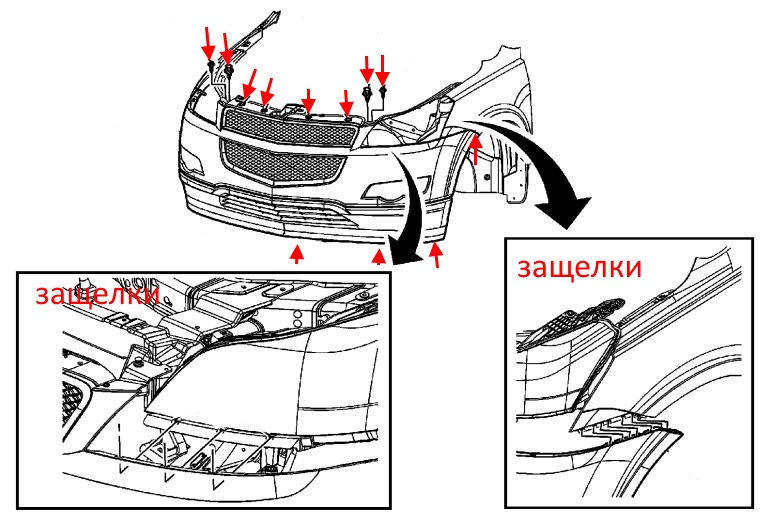
  1. Lift the hood up.
  2. Remove eight clips and take off the protective trim cover.
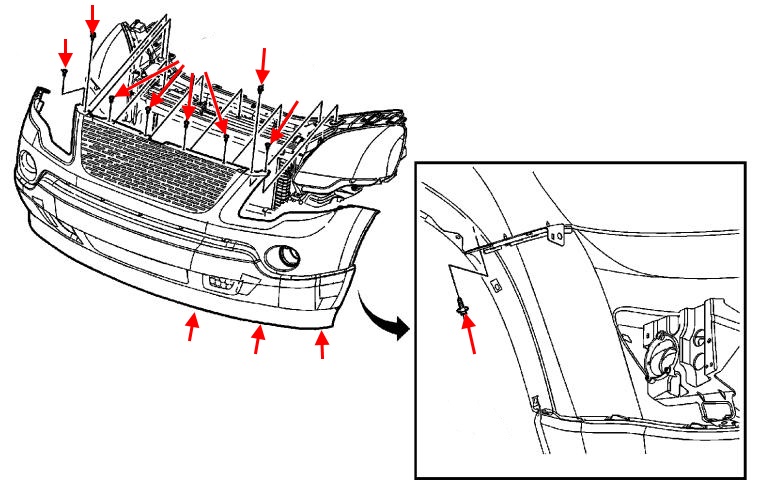
  3. Under the trim, unscrew seven screws that secure the radiator grille and the upper part of the front bumper.
  4. Move under the vehicle and unscrew six screws that are installed from the bottom up.
  5. Turn the wheels to the side.
  6. In the wheel wells, unscrew five screws on the left and right sides that secure the fender flares and wheel arch liners to the bumper.
  7. Remove two clips and release the fender flares from the bumper's retaining tabs.
  8. Pull the wheel arch liners aside and unscrew one screw on the left and right sides that secure the bumper corners to the fenders.
  9. Release the retainers in the fenders and, with an assistant, remove the bumper by pulling it forward.
  10. Disconnect the electrical connectors.

Buick Enclave I front bumper mounting locations

Buick Enclave I front bumper mounting diagram


How to Remove the Rear Bumper

⇒Useful tips on how to remove the bumper and not break anything.⇐

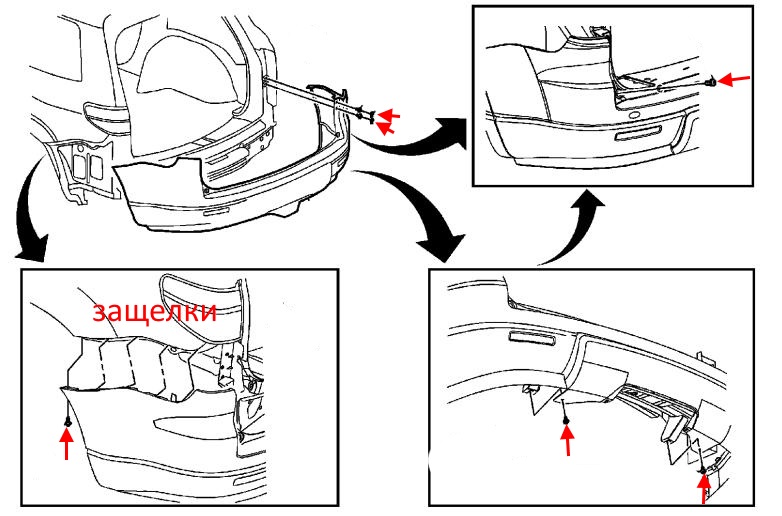
  1. Open the tailgate.
  2. In the tailgate opening, remove four covers and unscrew six screws that secure the upper part of the rear bumper.
  3. Move to the lower part, unscrew two screws, and remove two clips.
  4. Now, in the wheel wells, unscrew five screws on the left and right sides that secure the rear part of the wheel arch liners and fender flares.
  5. Release the fender flares from the retainers. Reach your hand behind the wheel arch liner, press on the retainers with your fingers, and pull the flares towards you.
  6. Pull the wheel arch liners aside and unscrew one screw on the left and right sides that are installed from the bottom up and secure the bumper corners to the fenders.
  7. Release the retainers in the fenders by sharply pulling the corners towards you.
  8. Remove the bumper by pulling it backward and disconnect the electrical connectors.

Buick Enclave I rear bumper mounting locations

Buick Enclave I rear bumper mounting diagram


Interesting Facts About the Model

  • Design from the Corvette Creator: The exterior of the first Enclave was designed by Korean designer Sang Yup Lee, who later worked on the design of the Chevrolet Corvette C7 and Bentley models. He gave the crossover its signature massive grille with vertical chrome bars, which became the new face of Buick.
  • Silence in the Details: The Enclave was the first vehicle in its class to use laminated (triplex) glass for the side windows, which, combined with an active noise cancellation system (ANC) through the Bose audio system, made it one of the quietest crossovers on the market.
  • Hybrid Prototype: In 2008, GM demonstrated a hybrid version of the Enclave, but it never went into production due to the complexity of integrating the Two-Mode Hybrid system with the heavy V6, which did not yield the expected increase in fuel economy.


Advantages

  • Spacious Interior: It is one of the few crossovers of its time where the third-row seats are genuinely suitable for adult passengers. The vehicle accommodated 7 or 8 people with a full-fledged cargo area behind the third row.
  • Suspension Comfort: The hydraulic suspension provides "American" ride smoothness that surpasses many of its classmates. On uneven roads, this vehicle maintains impeccable directional stability.
  • Corrosion Resistance: Unlike many modern competitors (particularly Japanese ones), the galvanization of the GMT967 body is done well. Structural elements and rocker panels are resistant to rust even in regions with aggressive winter road chemicals.

Disadvantages

  • Timing Chain Reliability: On pre-facelift versions (LY7) and early LLT engines (2012–2013), chain tensioners often failed between 50,000 and 62,000 miles (80–100,000 km). If you ignore the rattling sound during startup, the chain can jump, leading to major engine repair.
  • Transmission and Cooling System: The standard transmission oil cooler, integrated into the main engine radiator, is prone to clogging. This leads to transmission overheating and failure of the valve body (solenoids). The solution is to install an additional external cooler.
  • Electronics and Air Dampers: Over time, the climate control damper actuators fail (characteristic clicking or crackling noise behind the dashboard). Additionally, there is a known issue with the connectors in the airbag control module (SRS) located under the front seats, which causes a false error indicator.